
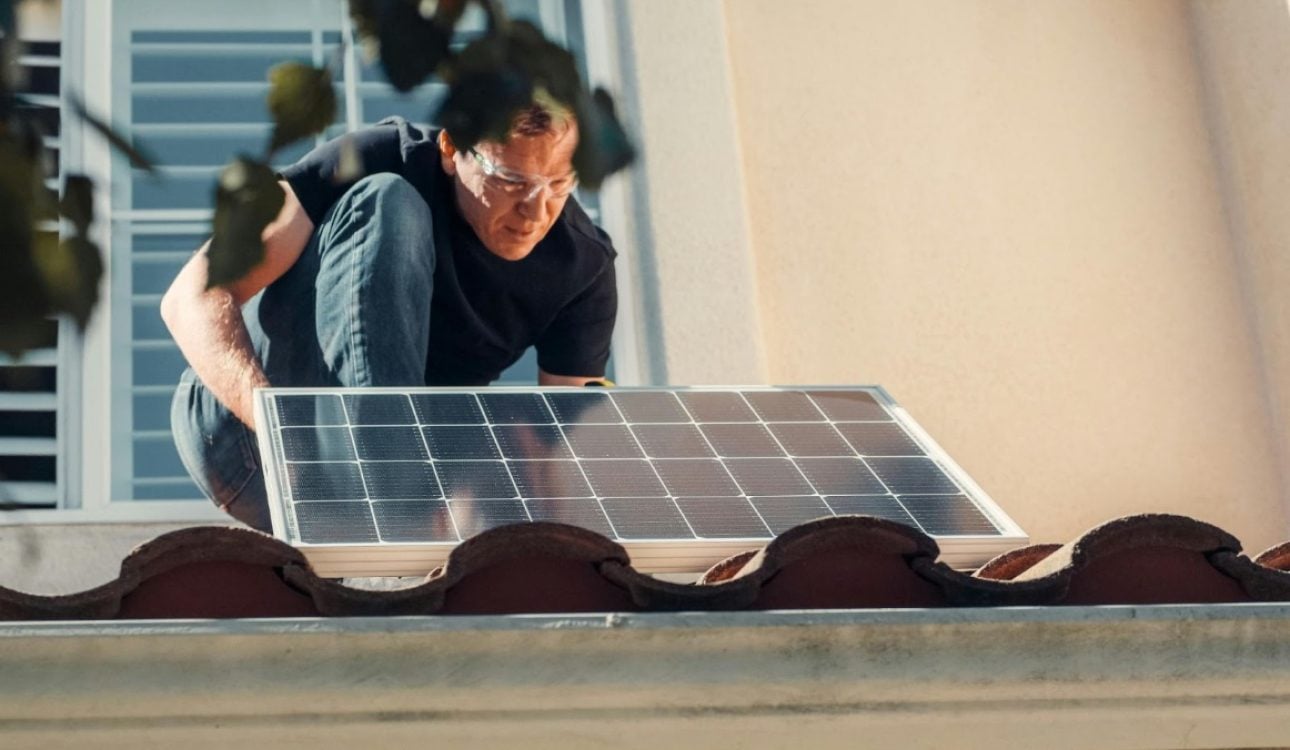

For shaded UK homes, south-facing panels remain ideal, but east/west orientations still generate 80-90% efficiency. Modern solar technology works effectively on partially shaded roofs when properly positioned. Strategic panel placement across different roof faces can optimise energy production throughout the day despite less-than-perfect conditions.

Forget the myth that solar panels only work on perfect south-facing, unshaded roofs. Many UK homeowners miss out on substantial energy savings because of this outdated thinking. Modern solar technology works effectively on east-facing, west-facing, and even partially shaded roofs when properly designed and installed.
Key Takeaways
- South-facing orientation is optimal in the UK, but east/west-facing panels still achieve 80-90% efficiency and can better match household energy usage patterns.
- Modern technologies like microinverters and power optimisers can reduce shading losses from 50-80% down to just 10-30%, making partially shaded roofs viable.
- Strategic panel placement across different roof faces, combined with appropriate shading mitigation technology, delivers better results than attempting to cover every available roof surface.
Does Roof Orientation Matter for Solar Panels?
Yes, orientation matters. It influences solar panel performance, but not as drastically as many believe. South-facing roofs remain the gold standard in the UK, capturing maximum sunlight throughout the day.
However, homes with southeast or southwest-facing roofs still generate impressive results, typically 80-90% of what perfectly south-facing systems produce.

This shows your “imperfect” roof orientation likely remains a viable candidate for solar installation.
The tilt angle also plays a crucial role. In the UK, the ideal angle ranges between 20-50°, with southern England benefiting from around 30° and northern Scotland closer to 40° to better capture the lower winter sun.
For flat roofs, mounting frames typically set panels at 30-35° for optimal performance throughout the year.
Are East or West Facing Solar Panels Effective?
Absolutely! East or west-facing solar panels can be remarkably effective, especially when matched to your household’s energy usage patterns.
East-facing panels capture morning sunlight, producing most electricity before midday. This suits homes where morning energy demand is high, perhaps for breakfast preparation or getting ready for work and school.
West-facing panels perform best in the afternoon and early evening, coinciding with when many families return home and energy usage peaks. This natural alignment with evening demand can reduce reliance on grid electricity during expensive peak tariff hours.
An increasingly popular strategy involves splitting your solar array across both east and west roof faces, creating a more balanced generation profile throughout the day. This approach:
- Smooths out production across daylight hours
- Reduces the impact of time-specific shading issues
- Aligns better with typical household consumption patterns
- Makes better use of available roof space
This east-west split can be particularly valuable for homes with time-of-use electricity tariffs, helping to offset grid electricity when it’s most expensive.
Can Solar Panels Work on Shaded Roofs?
Shade represents the biggest challenge for solar panel performance. Common sources include trees, chimneys, neighbouring buildings, and satellite dishes. Without appropriate mitigation technologies, even partial shading can reduce system output by 50-80%.
The problem stems from how traditional solar panels are wired. In standard string configurations, panels operate in series; when shade covers even a small portion of one panel, it can dramatically reduce the output of the entire connected string.
Seasonal shade variations also matter. A roof might be fully exposed in summer but partially shaded in winter when the sun sits lower in the sky.
Shade Mitigation Technologies
Modern technology has largely solved the shading problem through two main approaches:
- Microinverters: These small devices attach to each panel individually, converting DC electricity to AC at the panel level. This means each panel operates independently, so a shaded panel won’t drag down the performance of unshaded ones.
- Power Optimisers: Similar to microinverters but with slight differences, these devices optimise power at the panel level while still utilising a central inverter. They allow each panel to perform at its maximum potential regardless of what other panels are doing.
Both technologies add cost to your installation but can boost overall system yield by 10-25% in partially shaded conditions, often delivering excellent return on investment.
Modern solar panels also feature bypass diodes that limit the impact of shading on individual cells, though they don’t completely eliminate the problem like panel-level electronics do.
Smart Design Tips for Maximising Solar Output
Thoughtful system design makes all the difference for non-ideal roof conditions. Professional assessments identify optimal panel placement to minimise shading impacts and maximise energy harvest throughout the year.

Strategic Panel Placement
Position panels to avoid consistent shade, especially during peak production hours from mid-morning to early afternoon. Even if this means using less roof space, prioritising unshaded areas yields better results than covering every available surface.
For multi-faceted roofs, spreading panels across different orientations captures sunlight throughout the day. This approach works particularly well when combined with microinverters or power optimisers that allow each section to operate at its maximum potential.
System Configuration Options
The physical arrangement of your panels matters significantly. When shade moves across your roof during the day, orienting panels to experience shade simultaneously rather than sequentially improves overall system performance.
Consider panel technology based on your specific shading conditions:
| Shading Condition | Recommended Technology |
|---|---|
| Minimal, occasional shade | Standard string inverter with optimisers |
| Moderate, predictable shade | Power optimisers |
| Heavy or variable shade | Microinverters |
| Consistent shade patterns | Half-cut cell panels |
Maintenance Considerations
Regular maintenance significantly impacts performance, especially for systems with shading challenges. Annual panel cleaning removes dust and debris that exacerbate shading effects.
Trimming trees and vegetation around your property prevents shade encroachment. Small changes in shading patterns can dramatically affect yearly energy yields, so staying proactive with landscape maintenance pays dividends.
Conclusion
An east-facing roof or nearby trees shouldn’t stop you from embracing solar power. With modern technology and smart system design, most UK homes can benefit from solar energy despite less-than-perfect conditions. For a personalised assessment of your roof’s solar potential, contact our solar installation specialists today and discover how much you could save with a custom-designed solar installation that works with your unique roof conditions.
FAQs
Do solar panels work on cloudy days in the UK?
Yes, modern solar panels operate at up to 80% capacity even under diffuse light conditions. While output decreases on overcast days, the UK’s frequent cloud cover doesn’t prevent solar panels from generating useful electricity year-round.
What’s better: fewer south-facing panels or more east/west panels?
For many UK homes, more east/west panels often generate more total energy than fewer south-facing panels. While each east/west panel produces less, the increased panel count typically compensates for the reduced efficiency, resulting in higher overall generation.
How much energy do I lose with a shaded roof?
Without mitigation technology, shaded panels can lose 50-80% of potential output. However, with microinverters or power optimisers, this loss can be reduced to 10-30%, making even partially shaded roofs viable for solar installation.
Will a battery help if my panels don’t get full sun?
A battery system won’t increase generation from shaded panels but will maximise the usefulness of the electricity they do produce. By storing energy for use during peak demand times, batteries help extract maximum value from sub-optimal solar configurations.
Are there special solar panels designed for shade tolerance?
Yes, several panel designs offer improved shade tolerance. Half-cut cell panels, shingled cell technology, and panels with bypass diodes all perform better in partial shade conditions than traditional designs.
How does the Smart Export Guarantee work with non-optimal systems?
The Smart Export Guarantee pays for excess electricity exported to the grid regardless of how your system is oriented. While non-optimal systems may export less energy, they still qualify for the same per-kWh rate as perfectly oriented installations.
