

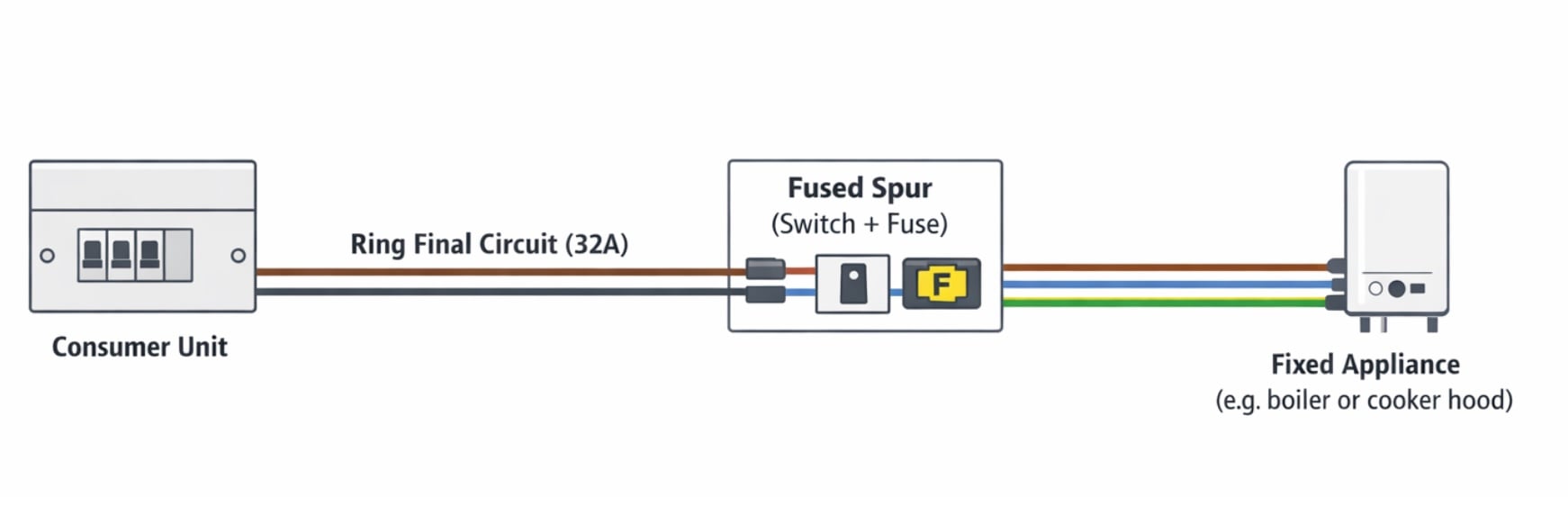
A fused spur is required in UK wiring when hard-wiring fixed appliances, adding sockets from ring circuits, or providing local isolation. It protects cables and devices while ensuring BS 7671 compliance.
Fused spurs confuse more homeowners and DIY enthusiasts than almost any other electrical component. These little boxes play a vital safety role, yet countless installations get them wrong. Understanding when you need one and how to wire a fused spur correctly could prevent fire risks and costly failures.
Key Takeaways
- Fused spurs are required for fixed appliances like boilers, cooker hoods and bathroom extractors to provide local isolation and cable protection.
- UK regulations under BS 7671 and Part P demand correct fuse ratings, proper installation and certification for notifiable work.
- Professional installation ensures safety, compliance and long-term reliability, especially in special locations like bathrooms and outdoor areas.
What a Fused Spur Is and Why It’s Used
A fused spur, also known as a fused connection unit or FCU, is a fixed wiring point that connects an appliance directly to your electrics rather than using a plug. Unlike a standard socket, it has its own internal fuse, usually between 3A and 13A.
This fuse protects the cable and appliance, especially where there’s no plug fuse in place, and often includes a handy on/off switch for isolation. If your circuit breaker is rated at 32A but your cable to a bathroom fan can only handle 3A, that fuse stops the cable from overheating if something goes wrong.
The BS 7671 Wiring Regulations provide detailed guidance on fuse protection and circuit design, making fused spurs an essential component in compliant installations.
When a Fused Spur Is Required in UK Wiring
A fused spur is typically required when an appliance is permanently connected rather than plugged in, such as a boiler, cooker hood or extractor fan. It’s also used where local isolation is needed for servicing or safety without switching off the entire circuit. In many installations, it’s the safest and most practical way to meet UK wiring requirements.
Fixed appliances that can’t be unplugged are the most common reason a fused spur is needed.
Boilers, extractor fans, cooker hoods and under-unit lighting are all hard-wired, so there’s no plug fuse to protect the cable.
A fused spur fills that gap and keeps things safe. It also provides local isolation, which is important for servicing. Engineers need to turn appliances off quickly without heading back to the consumer unit.
Fused spurs are also used when adding sockets to a ring final circuit, limiting the load on the spur cable. Even where not strictly required, they’re often the sensible choice for outdoor and garage supplies.
Where Fused Spurs Are Commonly Installed
Fused spurs are most commonly installed in areas of the home where appliances are fixed in place, exposed to heat or moisture, or need a reliable way to be isolated for safety and maintenance. In these locations, standard plug sockets aren’t always suitable, either because of access, environmental conditions, or wiring regulations.
This section looks at where fused spurs are typically used in UK homes and why they’re often the preferred solution.
Kitchens
Kitchens are one of the most common places you’ll find fused spurs, mainly because so many appliances are built in rather than plugged in.
Cooker hoods, integrated dishwashers, fridges and under-unit lighting are usually hard-wired, which makes a fused spur the safest way to connect them. It provides proper fuse protection for the cable and a convenient way to isolate the appliance without pulling units apart or switching off the whole circuit.
Bathrooms
In bathrooms, safety is the priority. Extractor fans, electric showers and heated towel rails often need to be hard-wired, but strict zoning rules limit where accessories can be fitted.
A fused spur is typically installed outside the bathroom or in a permitted zone, allowing the appliance to be safely isolated while keeping everything compliant with UK regulations.
Electrical work in bathrooms is treated more strictly under UK regulations. Under Building Regulations Part P, this type of work is classed as notifiable, meaning it must be installed, tested and certified by a qualified electrician before being put into service.
Outdoor Areas
Outdoor equipment such as garden lighting, sheds and garage supplies are often fed through fused spurs to protect the cable from overload and environmental stress.
They’re a practical way to control external circuits while keeping the main consumer unit untouched.
The location matters as much as the component itself.
Fused spurs in kitchens typically mount above worktop height, where they’re accessible but out of the way. Bathroom units must comply with zone regulations. Outdoor spurs need IP-rated enclosures rated IP65 or higher if exposed to weather.
How to Wire a Fused Spur Safely
Wiring a fused spur follows a clear sequence and needs to be done properly from the outset. It’s not something to wing, and each stage has a purpose, from isolating the supply to checking everything works as it should.
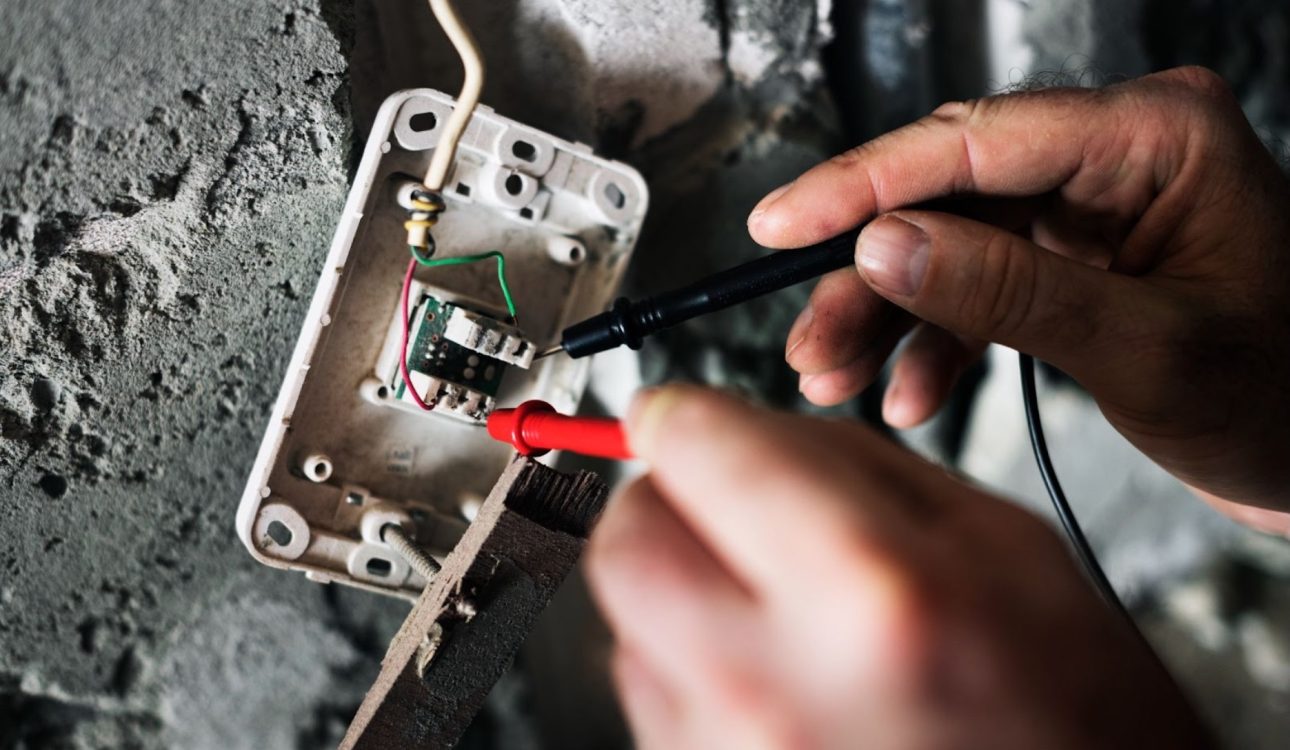
If you’re not confident or qualified, don’t attempt this work yourself. Electrical work must be carried out safely and by competent people to avoid serious risk (otherwise, improper electrical work can lead to serious injury or danger).
Below, we’ll outline how the process is normally approached, so you know what’s involved without it turning into a DIY guide.
Step-by-Step Wiring Overview
This is guidance for understanding the process, not a DIY manual. Qualified electricians follow these principles when they install fused spurs properly.
Step 1: Identify your cables
Your supply cable comes from the ring circuit or distribution point. Your load cable goes to the appliance. Mark them clearly before connecting anything.
Step 2: Prepare the cables
Strip back the outer sheath carefully without damaging the inner insulation. Prepare the conductors to the correct length. Fit earth sleeving on bare earth wires.
Step 3: Make terminal connections
Connect live, neutral and earth from your supply to the input terminals. Then connect live, neutral and earth to the output terminals feeding your load. Tighten all connections firmly but don’t overtighten and damage the terminals.
Step 4: Install the fuse
Fit the correct rated fuse into the holder. Many electricians test without the fuse first to check for shorts, then install it once everything checks out.
Step 5: Secure and test
Mount the faceplate securely. Restore power. Test the installation with appropriate equipment. Check voltage, polarity and earth continuity as minimum requirements.
Correct Fuse Ratings for Fused Spurs
Getting the fuse rating wrong causes more problems than you might expect. Fires, cable damage and appliance failures often trace back to incorrect fusing decisions.
Many people assume every fused spur needs a 13A fuse. Wrong. The fuse should match the load and protect the cable, not just default to maximum.
A bathroom extractor fan drawing 0.2A on a 13A fuse offers practically no protection if the cable shorts. That 13A fuse won’t blow until current exceeds its rating significantly. Meanwhile, your 1mm² cable might be melting.
| Appliance Type | Typical Power Draw | Recommended Fuse |
|---|---|---|
| LED bathroom fan | 10–25W | 3A |
| Standard extractor fan | 25–50W | 3A or 5A |
| Cooker hood | 100–300W | 3A or 5A |
| Electric towel rail | 100–200W | 3A or 5A |
| Boiler | 50–200W | 3A or 5A |
| Dishwasher | 2000–2500W | 13A |
| Waste disposal unit | 400–700W | 5A or 13A |
You cannot create a spur from another spur. If you’ve already taken a fused spur from your ring circuit, you cannot then take another spur from that first one.
This is fundamental to ring circuit design. Spurs create a weak point. Spurring from a spur creates a weaker point. Eventually you overload cables or lose proper protection.
Common DIY Fused Spur Mistakes Electricians Encounter
Reversed polarity happens surprisingly often. Live and neutral get swapped at the terminals. The appliance might still work, but you’ve created a shock risk.
Missing earth connections are dangerous. Some older properties have odd wiring. Never assume the earth isn’t needed just because it wasn’t there before.
Poorly tightened terminals cause arcing, heat buildup and eventual failure. Terminal screws need firm tightening with a proper screwdriver, not hand tight.
According to Electrical Safety First statistics, electrical faults remain a leading cause of house fires in England. Many involve incorrectly installed or maintained electrical accessories including fused spurs.
Fused Spur Testing and Certification
Once a fused spur has been installed, it needs to be properly tested to make sure it’s safe and working as intended.
This includes checks on continuity, insulation resistance and earth fault protection, all of which confirm the wiring has been connected correctly and won’t pose a risk.
In many cases, especially in kitchens, bathrooms or rental properties, the work must also be certified to meet UK regulations. This is where a qualified electrician is required. They can carry out the necessary testing, issue the correct paperwork and confirm the installation complies with Part P and BS 7671.
For landlords, this ties in with EICR requirements, helping demonstrate that the property’s electrical system is safe and legally compliant.
When You Must Hire a Qualified Electrician
If you’re uncertain about any aspect of electrical work, stop. Call a qualified electrician. The cost of proper installation is tiny compared to the cost of fire damage, injury or insurance problems. Modern electrical installations also integrate with consumer units containing RCBOs and RCDs. Understanding how your fused spur interacts with these protective devices requires professional knowledge.
When we handle consumer unit and fuse box upgrades, we ensure every downstream circuit, including fused spurs, coordinates properly with the protection devices.
Conclusion
If you’re planning kitchen work, bathroom upgrades or outdoor electrical projects, proper fused spur installation should be part of your specification. The small investment in professional electrical work protects your property and your family far beyond its cost.
Need expert advice on electrical installations? We’d love to help you get your wiring right first time. Get in touch with us today for professional installation, testing and certification you can trust.
FAQs
Do I legally need a fused spur for a boiler in the UK?
Not strictly by law, but most manufacturers require one. A fused spur provides local isolation for servicing and is widely accepted as best practice.
Can I run a socket from a fused spur?
Yes, but only one single or double socket. It must be supplied directly from the ring or radial circuit, not from another spur.
What fuse size should I use in a fused spur?
It depends on the load. Small fans use 3A, medium appliances around 5A, and larger kitchen appliances may need 13A.
Can I install a fused spur myself?
Only if you’re properly qualified. Work in kitchens or bathrooms is often notifiable under Part P, and testing is essential.
Is a fused spur required in bathrooms or outside?
Bathrooms don’t allow standard sockets, so fused spurs are used for fixed appliances. Outdoor supplies also benefit from fused, weatherproof protection.
