
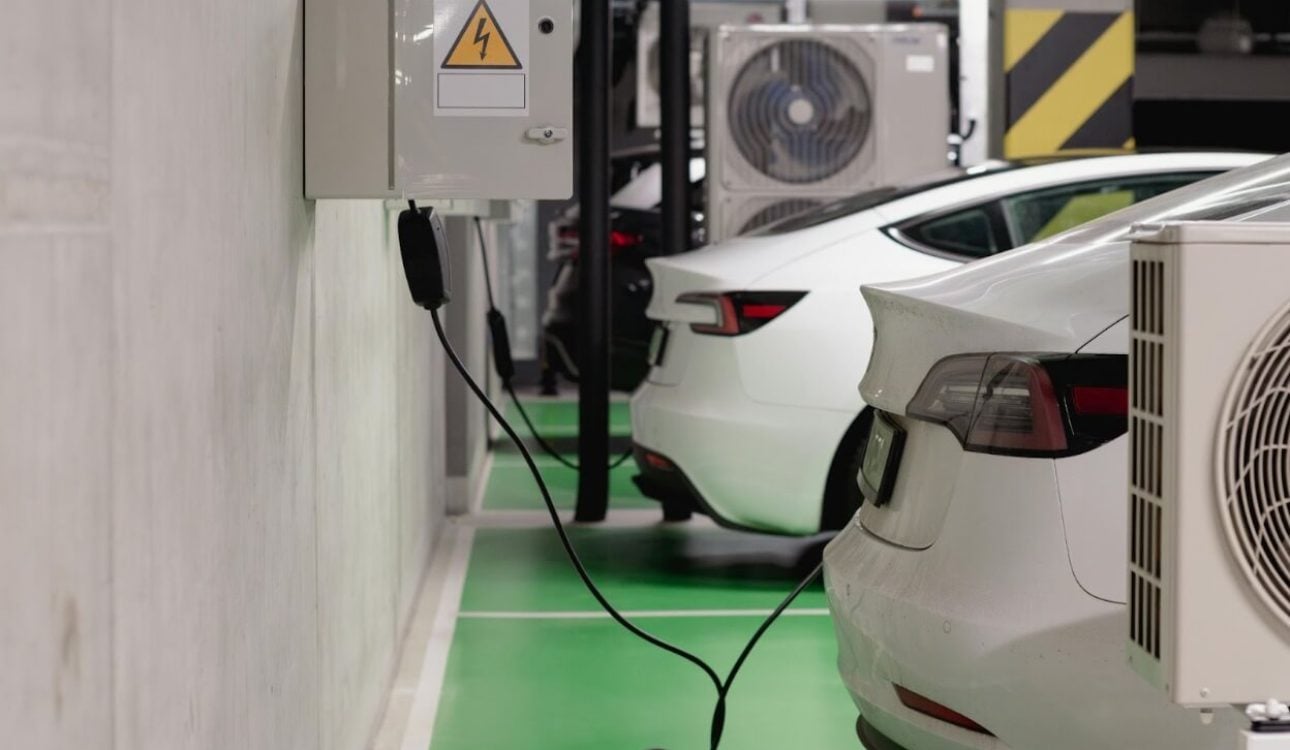

Yes, you can charge two EVs with one home charging system using either sequential charging (one after another) or simultaneous charging with a dual-port charger that splits power between vehicles. Smart chargers with load balancing ensure safe distribution of electricity without exceeding your home’s capacity.

With over 1.5 million electric vehicles now on UK roads and multi-car households on the rise, efficient home charging solutions for multiple EVs have become essential. The average UK household with two cars needs practical, cost-effective charging options that don’t require extensive electrical upgrades or double the equipment costs.
Key Takeaways:
- Dual-port EV chargers allow simultaneous charging of two vehicles by splitting available power, typically providing around 3.5kW to each vehicle from a standard 7kW system.
- Sequential charging is a cost-effective solution for most UK households, as the average daily commute requires only 1-1.5 hours of charging time per vehicle.
- Smart chargers with load balancing capabilities prevent electrical overloads by monitoring your home’s power usage and adjusting EV charging rates accordingly.
Can You Charge Two EVs From One System
The simple answer is yes, you can charge two electric vehicles using a single home charging system. There are two main approaches to accomplish this:
Sequential Charging
The most straightforward method is to charge your EVs one after another. Most UK households don’t need to charge their electric vehicles every day.
The average UK car travels approximately 20-30 miles daily, which requires only about 6-9 kWh of electricity. A standard 7kW home charger can deliver this in just 1-1.5 hours.
This means you could easily charge one car for a couple of hours, then switch to the second vehicle.
Simultaneous Charging with Dual Chargers
If you prefer to charge both vehicles at the same time, you’ll need a dual-port charger. These clever devices have two separate charging points connected to a single power supply.
A dual charger splits the available electricity between both vehicles. With a standard 7kW single-phase supply, each car would receive around 3.5kW when charging simultaneously.
This is slower than the full 7kW, but still adds approximately 15-20 miles of range per hour to each vehicle, which is plenty for most daily driving needs.
How Load Balancing and Smart Chargers Work
Load balancing is a smart feature that distributes available electrical power between multiple charging points or between your charger and other household appliances.
When two EVs are connected to a dual charger or two separate smart chargers, the system monitors the total electrical load and divides it appropriately. This prevents circuit overloads and ensures your home’s electrical system stays within safe limits.
For example, if your home has a 100-amp supply and your EV charger detects that 60 amps are currently being used by other appliances, it might limit EV charging to 40 amps to prevent exceeding your home’s capacity.
Smart Charger Requirements in the UK
Since June 2022, all new home and workplace EV chargers sold in Great Britain must include smart functionality under The Electric Vehicles (Smart Charge Points) Regulations. These regulations require chargers to:
- Include load management capabilities
- Offer remote communication features
- Maintain appropriate security standards
- Default to off-peak charging when possible
These smart features are particularly valuable for multi-EV households as they facilitate efficient power sharing between vehicles.
Power Setup Needed for Dual EV Charging
Most UK homes have a single-phase power supply, typically allowing for a 7kW charger. This is sufficient for most dual EV charging needs through either sequential charging or power-sharing.
Three-phase power can deliver up to 22kW, allowing both vehicles to charge at higher speeds simultaneously. However, three-phase supplies are less common in UK homes and can be expensive to install.

Best Dual EV Chargers in the UK Market
If you’re considering a dual charging setup, several excellent options are available in the UK market.
| Charger Model | Power Output | Key Features | Approximate Cost |
|---|---|---|---|
| Zappi V2 Dual | 7.4kW (shared) | Solar integration, app control, eco modes | £1,100–£1,300 |
| EO Mini Pro 2 Dual | 7.4kW (shared) | Compact design, OLEV approved, 3-year warranty | £900–£1,100 |
| Wallbox Pulsar Plus Dual | 7.4kW (shared) | Power balancing, facial recognition, Bluetooth | £1,000–£1,200 |
| Andersen A2 Dual | 7.4kW (shared) | Hidden cable storage, premium design, scheduling | £1,300–£1,500 |
These dual chargers all feature smart functionality, allowing you to monitor and control charging via smartphone apps. They also include load balancing to safely distribute power between two connected vehicles.
When to Install Two Separate Charging Units
While dual chargers offer convenience and cost savings, there are situations where installing two separate units might be preferable:
High Mileage Households
If both vehicles regularly travel long distances and need frequent fast charging, two separate units might be better. This allows both vehicles to charge at the full 7kW rate simultaneously, provided your home’s electrical supply can support it.
Three-Phase Power Availability
If you already have three-phase power, installing two separate 7kW or 11kW chargers becomes more practical, as your electrical supply can handle the combined load.
Cost Considerations
Installing two separate basic chargers can sometimes be more cost-effective than a single premium dual charger, especially if you qualify for multiple grants.
Home charging costs around 8p per mile compared to 13-17p per mile for petrol or diesel vehicles. With off-peak tariffs, this can drop below 3p per mile, making home charging extremely cost-effective.
Space and Installation Factors
Consider your home layout and parking arrangements. Two separate chargers provide more flexibility in terms of where they can be installed, which might be beneficial depending on your property layout.
Expert Home EV Charging Solutions in Leeds
Getting the right charging setup for multiple electric vehicles requires professional assessment and installation. At West Yorkshire Electrical, we specialise in tailored EV charging solutions for homes across Leeds and the surrounding areas.
Our NICEIC-approved electricians can help you determine the most efficient and cost-effective charging system for your multi-EV household. Whether you need a dual charger, two separate units, or smart load management, we provide expert guidance and professional installation.
Book your EV charger installation today and take the step toward convenient, efficient home charging for all your electric vehicles.
FAQs
Do I need three-phase power to charge two EVs at once?
No. Most UK homes with standard single-phase power can charge two EVs simultaneously using a dual charger or two smart chargers with load balancing. You’ll simply share the available power between vehicles.
Is it better to install one dual-port charger or two singles?
It depends on your needs. A dual-port charger is usually more cost-effective and takes up less space. Two separate chargers offer more flexibility and allow full-speed charging for both vehicles if your electrical supply permits.
Will a dual EV charger slow down charging speed?
Yes, when charging two cars simultaneously. A standard 7kW charger will typically provide around 3.5-3.7kW to each vehicle when both are connected, roughly halving the charging speed.
Can I install two EV chargers at home?
Absolutely. Two separate chargers can be installed as long as your electrical supply can handle the load. Modern smart chargers can communicate with each other to balance the power demand.
What are the running costs of charging two EVs?
At average UK electricity rates (28-34p per kWh), charging costs around 7-9p per mile. Charging two EVs at home could cost £800-£1,500 annually, depending on your mileage and electricity tariff.
Are there smart features that help manage dual charging?
Yes. Features like scheduled charging, power balancing, and integration with time-of-use tariffs help manage dual charging efficiently. Some systems even integrate with solar panels to optimise renewable energy use.
