

An EV charger does not always need a new consumer unit. A modern board with suitable protection and spare capacity can often take a dedicated circuit, while older boards may need replacing.
An EV charger consumer unit needs to cope with a substantial electrical load for an extended period. That can expose limitations in older fuse boxes or already busy domestic installations. A modern consumer unit may be suitable without being replaced. Other properties may need a new board or separate unit to provide the required protection and capacity.
Key Takeaways
- Modern boards with spare capacity can often be retained.
- Older fuse boxes may lack the protection a charger needs.
- Every EV charger needs its own dedicated circuit under BS 7671 Section 722.
- An electrician must assess the installation before deciding on the consumer unit.
Can an EV Charger Use Your Existing Consumer Unit?
Yes, in many homes it can. Replacing the whole consumer unit is not automatically required simply because an EV charger is being added.
When the Existing Consumer Unit May Be Suitable
An existing board may be suitable when it has appropriate RCD or RCBO protection, a spare way for the dedicated EV circuit and enough available capacity for the additional load. The electrician still needs to check the condition of the board and the wider electrical installation before confirming that it can be used.
According to the IET consumer unit guidance, consumer units in domestic premises have required non combustible enclosures since January 2016. Older boards may therefore have plastic or other outdated enclosures and may lack the protection expected of a modern installation.
The age and design of the consumer unit can therefore affect whether the EV charging circuit can be added to the existing board or whether an upgrade is required.
What an Installer Checks First
Before connecting the charger, the installer needs to look beyond the number of empty spaces in the board. They will assess the age and condition of the consumer unit, the enclosure, existing MCBs or RCBOs, available spare ways, earthing arrangement and overall supply capacity.
The electrician also needs to establish how the new charging load will affect the existing installation. Our EV charger installation service can assess these points as part of the installation process.
When Might You Need a New or Separate Consumer Unit for an EV Charger?
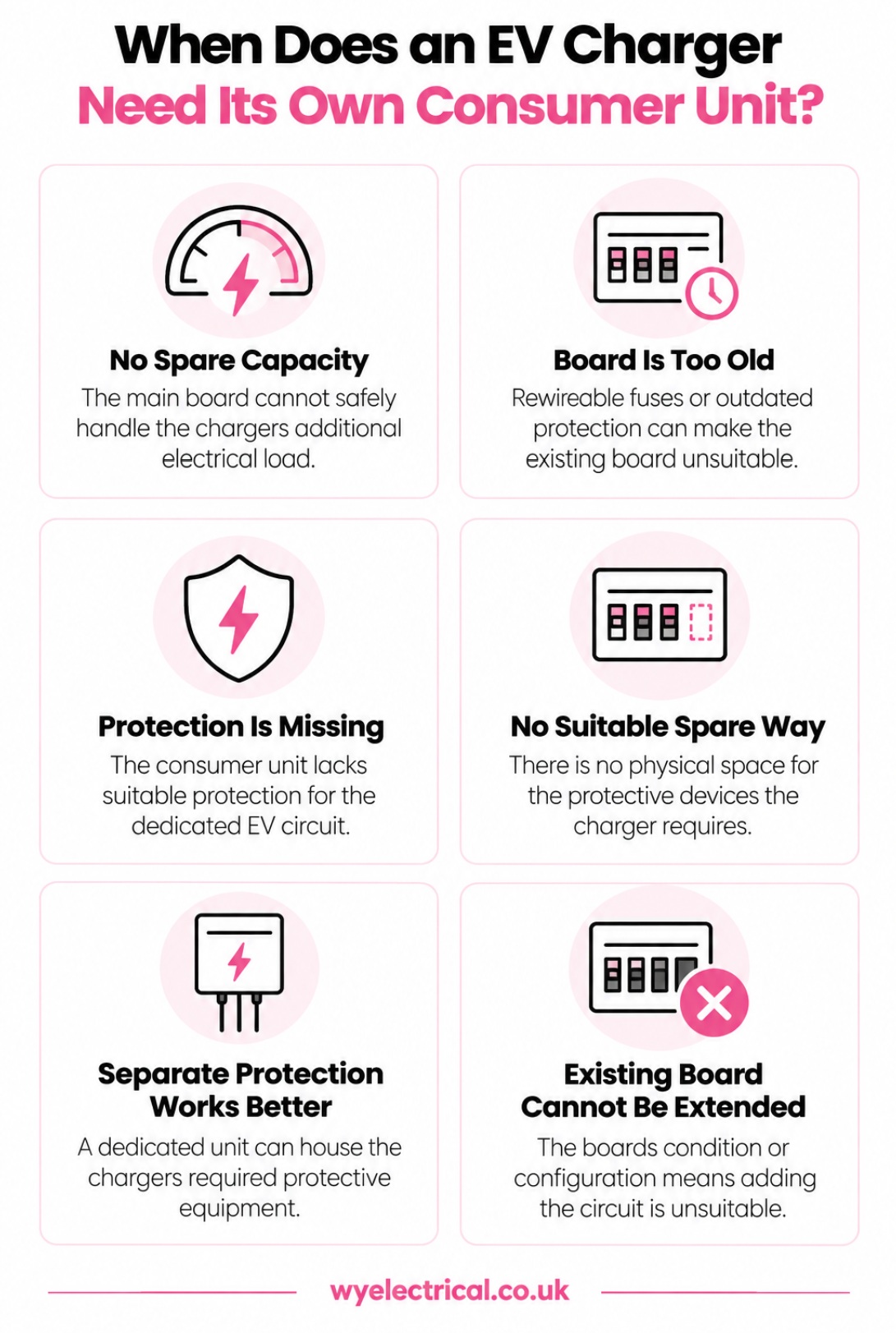
A new or separate consumer unit becomes more likely when the existing board cannot provide the space, protection or capacity required for the new charging circuit. Several situations can lead to that decision.
The Existing Consumer Unit Has No Spare Capacity
An EV charger places a significant continuous demand on the electrical installation. The existing board may already be carrying several circuits close to its available capacity, leaving no suitable way to add the charger.
The electrician will assess the installation rather than judging capacity from the number of sockets or rooms in the house. Depending on the findings, the solution may be a replacement consumer unit or a separate unit for the charger.
The Existing Consumer Unit Is Too Old
Older boards can contain rewireable fuses, outdated protective arrangements or enclosures that do not meet current requirements. These features can make extending the installation unsuitable.
A board that predates modern standards may therefore need upgrading before the charger is connected. The same issues can apply even when there appears to be physical space available.
You can read more about when to upgrade your consumer unit when assessing an older installation.
The EV Charger Needs a Dedicated Consumer Unit
A separate consumer unit can be used where the main board has limited space or cannot accommodate the protection required for the EV circuit. This gives the charger its own protective arrangement without necessarily replacing the property’s main board.
Whether that setup is appropriate depends on the existing installation and the way the charger needs to be supplied. The electrician should determine the arrangement during the assessment.
The Existing Consumer Unit Lacks Suitable Protection
An EV charging circuit needs appropriate protection against electrical faults. An older consumer unit may not have the protective devices required for the proposed charger installation.
Where the existing protection is unsuitable, adding another circuit alone may not be enough. The board may need to be modified or replaced so the charger can be connected safely.
There Is No Space for the Required Protection
Electrical capacity and physical space are not the same thing. A consumer unit may have enough overall capacity but no spare way for the protective equipment required by the EV charging circuit.
That can make a separate consumer unit a practical option. The installer will assess both the available capacity and the physical arrangement before deciding how the circuit should be connected.
What Electrical Requirements Does an EV Charger Need?
An EV charger places a substantial electrical demand on a home’s wiring, so the circuit needs to be designed around the charger’s expected load. A typical single phase home charger can provide around 7.4kW, which means the installation has to account for a high load operating continuously during charging.
Under BS 7671 Section 722, every EV charge point must be supplied by its own dedicated circuit. The circuit also needs suitable RCD protection, a means of isolation and an appropriate earthing arrangement.
The cable and protective devices must be correctly sized for the charging demand. The installer also needs to check the property’s incoming supply and existing electrical installation to establish whether they can safely support the additional load.
According to EV charging installation guidance, EV charger installation should be carried out by a competent, registered electrician. An existing consumer unit or wiring may also need upgrading where it cannot safely accommodate the charger.
Why the Decision Follows an Installer Assessment
You cannot reliably tell whether a consumer unit needs replacing simply by looking at the outside of the board. The answer depends on its age, protective devices, spare capacity, earthing arrangement and the characteristics of the property’s electrical supply.
The EV charger also needs its own dedicated circuit, so the installer has to establish whether the existing installation can accommodate that circuit safely.
This work is notifiable electrical work in England and Wales. It must be completed and certified through a registered Competent Person Scheme, such as NICEIC or NAPIT, or separately notified through the relevant building control route. The electric vehicle charging safety guidance also recommends using a registered, competent electrician for installation.
Why Consumer Unit Checks Matter for EV Chargers
Installing a home EV charger is becoming increasingly common as more UK households switch to electric vehicles.
Battery electric cars accounted for 19% of new UK car registrations by June 2024, compared with just 1% in 2018, and 1.09 million battery electric cars were already on UK roads at that point, according to the House of Commons Library. That growth has been accompanied by a large increase in domestic charging installations.
340,222 domestic charging devices were installed through the Electric Vehicle Homecharge Scheme between September 2014 and its closure in 2022, with £140.8 million in government grant funding. These figures are recorded in the EV charging device grant scheme statistics published by the Department for Transport.
Many of these chargers have been added to existing homes rather than new builds. That makes the condition of the existing electrical installation an important part of the installation process.
An installer needs to establish whether the consumer unit has the space, protection and capacity required for the new dedicated charging circuit. In some homes the existing board can be retained. In others, its condition or configuration means an upgrade is needed before the charger can be safely installed.
FAQs
Does every EV charger need a new consumer unit?
No. A modern consumer unit with suitable protection and spare capacity can often support a dedicated EV charging circuit.
What is a separate consumer unit for an EV charger?
It is an additional consumer unit dedicated to the charger. It can be used where the main board has limited space or cannot provide the required protection.
How do I know if my consumer unit has spare capacity?
An electrician needs to assess the board and the property’s electrical load. An empty space alone does not confirm that the installation has suitable capacity.
Can an old consumer unit be used for an EV charger?
Sometimes, but older boards may lack suitable protection or have outdated enclosures and wiring arrangements. The installation should be assessed before the charger is connected.
Who decides whether I need a new consumer unit?
A qualified electrician carrying out the EV charger assessment should determine whether the existing board can support the required circuit.
Does my energy supplier need to be notified about an EV charger?
The local Distribution Network Operator may need to be notified about the additional electrical load. This is separate from the question of whether the consumer unit needs replacing.
Does upgrading the consumer unit add to the cost of EV charger installation?
Yes. Replacing or adding a consumer unit involves additional equipment and labour, so it can increase the overall installation cost.
Conclusion
An EV charger does not automatically require a new consumer unit. The decision depends on the condition, capacity, protection and earthing arrangement of the existing installation, so a qualified assessment is the only reliable way to determine what your property needs.
Not sure whether your consumer unit is ready for an EV charger? Get a quote for a professional assessment and honest advice.
