
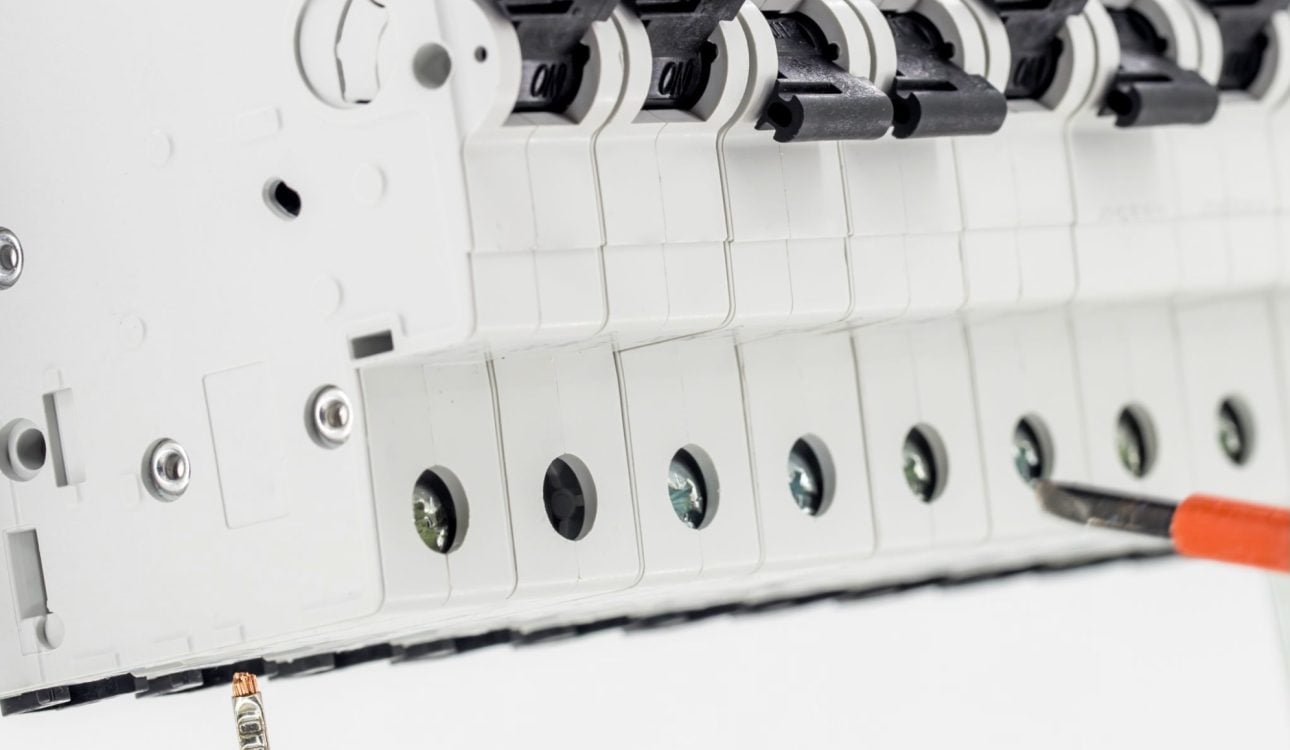

RCD type depends on the equipment connected. Type AC suits basic AC loads, while Types A, F and B handle modern electronics and DC faults.
The right RCD type depends on the equipment connected to the circuit. Types AC, A, F and B represent a progression from basic AC protection to wider waveform tolerance. Modern UK electrics include DC components and high-frequency leakage that affect how devices trip. Choosing the wrong type can mean inadequate protection or nuisance tripping.
Key Takeaways
- Type AC only detects pure AC faults and is unsuitable for modern electronics like EV chargers or solar systems.
- Type A handles AC and pulsating DC up to 6 mA, making it the safer default for homes.
- Types F and B provide broader protection for frequency-controlled loads, EV chargers, PV systems and battery storage.
What Is an RCD and How Does It Work?
An RCD is a safety device that detects faults in the electrical system and rapidly switches off the supply, reducing the risk of electrical injury. However, a shock can still cause very serious or fatal injuries.
For personal protection in the UK, RCDs should have a tripping current of no more than 30 milliamps. An RCD works as secondary protection, not as a substitute for proper electrical system design and safety measures. It should never be bypassed.
Important Note: If an RCD trips, it usually indicates a fault within the electrical system. The installation should be checked before it is used again. If the RCD continues to trip and no fault can be identified, consult the manufacturer. Most RCDs include a test button to confirm the mechanism is functioning correctly.
Why RCD Type Matters in Modern UK Installations
Modern appliances create leakage currents through capacitors used for filtering transients in their power supplies. Different equipment types have varying maximum leakage current values according to relevant standards.
The IET reports typical maximum leakage values for household appliances. Laptops produce 0.5 mA, fridges 1.5 mA, washing machines and dishwashers 5 mA each, and electric heat pumps 10 mA. These currents can accumulate on shared RCD circuits, potentially causing unwanted tripping.
Type AC RCDs struggle with DC leakage from modern electronic equipment and may become desensitised or blinded.
Type A, F or B RCDs provide better protection for installations with EVs, PV systems, variable speed drives and other electronic loads.
How RCD Types Detect Different Fault Currents
RCDs detect imbalance, but the type determines which waveforms they recognise as genuine faults.
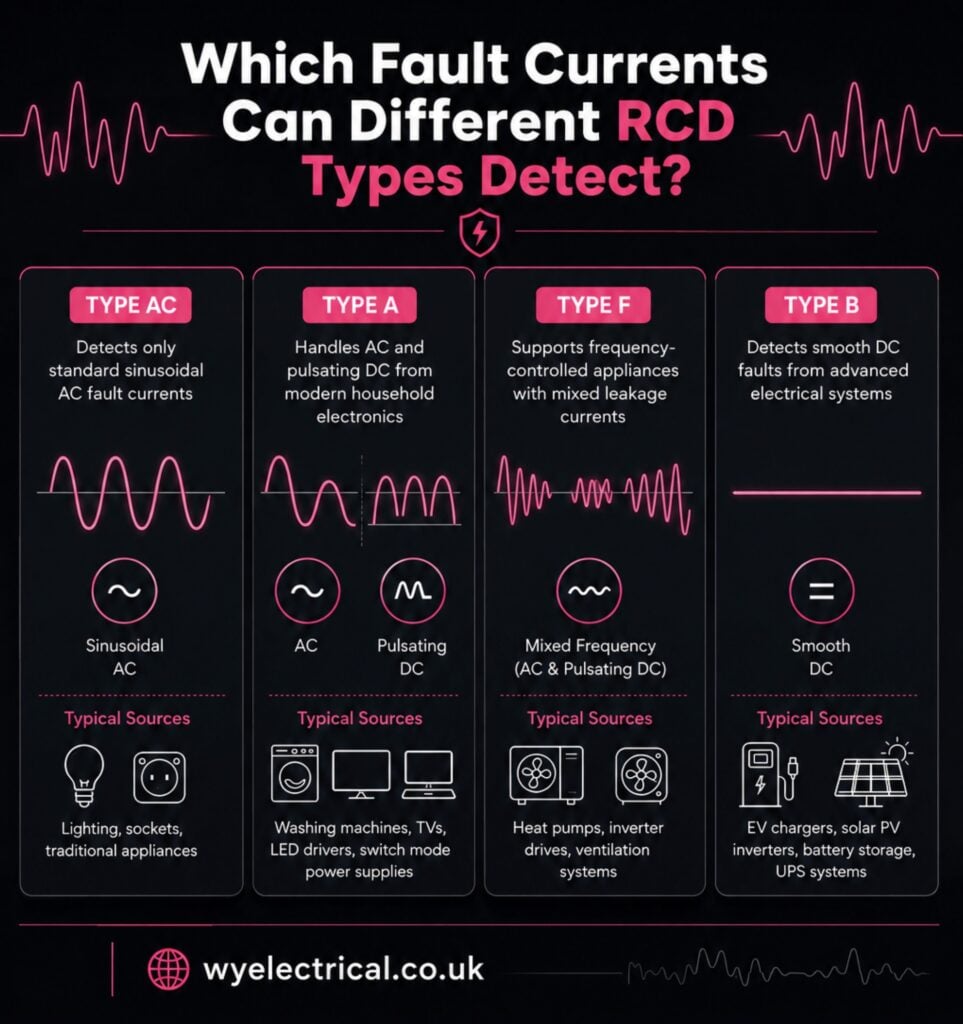
Understanding fault current types helps explain why selection matters.
AC Fault Currents
Traditional alternating current leakage happens when insulation fails or someone touches live parts. The current flows out and returns via earth instead of neutral. Type AC RCDs detect this pure sinusoidal 50 Hz fault.
Pulsating DC Fault Currents
Modern electronics, rectifiers and switching devices create pulsating DC. That happens when AC gets converted to DC through diodes or similar components. The current still alternates but includes a DC offset that Type AC may not detect reliably.
Smooth DC and Mixed Frequency Leakage
EV chargers, solar PV and variable speed drives can produce smooth DC or high frequency leakage. These waveforms fall outside the range Type AC and Type A handle. Type F and Type B extend detection capability to cover these modern loads.
Overview of RCD Types in the UK
RCD types differ in the fault waveforms they detect and the DC levels they tolerate. Choosing the right one depends on what equipment connects to the circuit.
Type AC
Type AC detects pure sinusoidal alternating current only. It was the standard for many years when loads were simpler. Electronic devices, inverters and chargers can create DC components that blind Type AC RCDs.
That makes Type AC unsuitable for mixed electronic installations. It remains acceptable for dedicated circuits with resistive loads only. Even then, Type A is the safer modern choice.
Type A
Type A handles AC and pulsating DC. It is designed for pulsating DC superimposed on smooth DC up to 6 mA. That covers typical household electronics, kitchen appliances and general socket circuits.
Type A is the more suitable default for modern domestic circuits. It costs slightly more than Type AC but provides better protection where electronics are present. Type A is the minimum for circuits with computers, TVs or any appliance containing power supplies.
Type F
Type F is intended for frequency-controlled loads. It offers broader tolerance than Type A. Type F covers pulsating DC superimposed on smooth DC up to 10 mA.
It suits washing machines, dishwashers, air conditioning and variable speed fans. Type F reduces nuisance tripping where inverters create higher frequency leakage. It bridges the gap between Type A and Type B.
Type B
Type B is the capable option of the four types. It responds to residual alternating currents up to 1 kHz and smooth DC. That makes it suitable for EV chargers, solar PV, battery storage and three-phase drives.
Type B is required where smooth DC faults are possible. It handles the full range of modern waveforms. Type B costs more and is larger than other types, so it appears mainly where specified by equipment or standards.
Which RCD Type Should You Use
Type A has become the safer modern choice over Type AC where electronic devices are present. Homes, kitchens, extensions and rewires typically need Type A as the baseline. Socket circuits serving modern electronics may require Type A or Type F, depending on the equipment characteristics.
EV charging demands more specialised protection.
Regulation 722.531.3.101 requires individual RCD protection of at least Type A with additional safeguards against DC fault currents exceeding 6 mA. This protection can be provided by Type B RCD, or Type A or F RCD working alongside a residual direct current detecting device.
Electrical installations in rented homes in England must be checked at least every five years by a properly qualified person. Government guidance confirms landlords must provide proof to tenants. Inspections verify RCD type suitability alongside other safety measures.
Our consumer unit replacement service upgrades older boards to modern RCD protection suited to your household loads.
| Application | Recommended RCD Type | Why It Is Used |
|---|---|---|
| Modern homes and rewires | Type A | Safer for circuits with modern electronic devices and now considered the standard choice over older Type AC units. |
| Kitchens and home extensions | Type A | Provides improved protection where appliances and electronic equipment are commonly used. |
| Socket circuits with sensitive electronics | Type A or Type F | Suitable for circuits serving modern electronics depending on the characteristics of the connected equipment. |
| EV charging installations | Type B or Type A/F with DC fault protection | Required to protect against DC fault currents above 6 mA in line with Regulation 722.531.3.101. |
| Rented properties in England | Appropriate RCD type confirmed during inspection | Electrical installations must be inspected at least every five years by a qualified person to confirm ongoing safety and compliance. |
| Consumer unit upgrades | Modern RCD protection | Replacing older consumer units improves protection and better supports modern household electrical demands. |
Signs Your Existing RCD May Need Upgrading
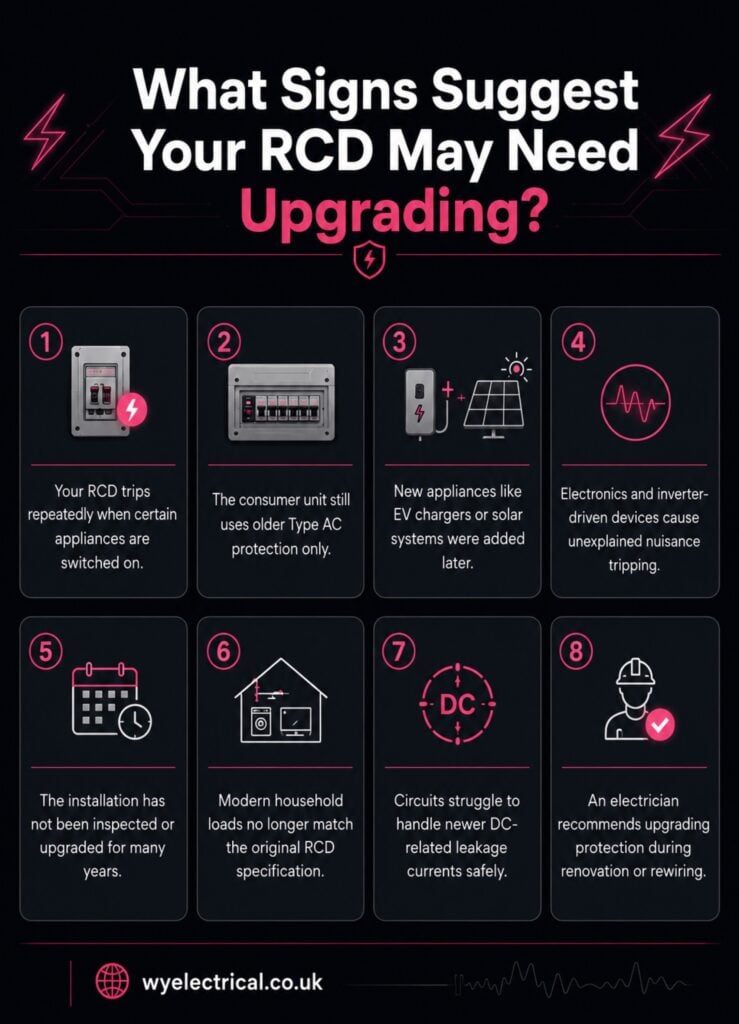
If your RCD trips regularly for no obvious reason, especially when using modern appliances, it may no longer suit the type of electrical loads in your home. Older Type AC RCDs often struggle with equipment that contains electronics, inverters, or variable speed motors, which can lead to nuisance tripping. In many cases, upgrading to a Type A or Type F RCD resolves the issue while providing more reliable protection.
Many consumer units installed before 2008 were fitted with Type AC RCDs because they met the standards at the time. However, modern homes now commonly use appliances and systems that produce DC leakage currents.
As new technology is added to a property, the original RCD arrangement may no longer provide the correct level of protection. A qualified electrician can assess whether your current RCD type is still suitable or if an upgrade is recommended to improve safety and reduce unnecessary tripping.
Mistakes Electricians and Homeowners Commonly Make With RCDs
Incorrect RCD selection is one of the most common causes of nuisance tripping and reduced electrical protection. Many people still assume all RCDs work the same way, but different installations require different RCD types depending on the equipment connected.
Common mistakes include:
- Using Type AC RCDs on circuits with modern electronic appliances, inverters, or EV chargers
- Overlooking DC leakage currents produced by solar PV systems, battery storage, or charging equipment
- Assuming every EV charger requires the same type of RCD without checking the manufacturer’s instructions
- Confusing RCDs with RCBOs and selecting the wrong protective device
- Installing Type A protection where Type F or Type B is actually required for variable frequency equipment
Although Type AC devices are still available, they are suitable for fewer applications than in the past. In many modern installations, Type A, Type F, or Type B RCDs provide safer and more reliable protection for today’s electrical loads.
Conclusion
RCD types are chosen for the load, not by habit. Type AC is increasingly unsuitable for modern installations. Types A, F and B handle electronics, inverters and DC faults that Type AC cannot detect reliably.
If you need an inspection, upgrade or professional advice on RCD selection, get a free quote from us, and we will assess your installation and recommend the right protection.
FAQs
What colour is the live wire in the UK?
Brown in modern installations from 2004 onwards, and red in older pre 2004 wiring. Always test before touching because colour alone cannot guarantee conductor status.
What were the old live wire colours?
Red indicated live, black showed neutral, and plain green marked earth in UK wiring installed before the mid 2000s harmonisation changes.
How do I know if I have old wiring?
Visible signs include red and black cables, fabric or rubber insulation, round pin sockets, and consumer units with rewirable fuses rather than modern circuit breakers.
Can black ever be live?
Yes in mixed systems where electricians re-identified neutral conductors as live using sleeving, or in older three-phase installations using different colour schemes.
Do flexible cables follow the same colours?
Modern plug leads use brown live, blue neutral, and green and yellow earth matching fixed wiring colours, though older appliances may have different schemes.
