
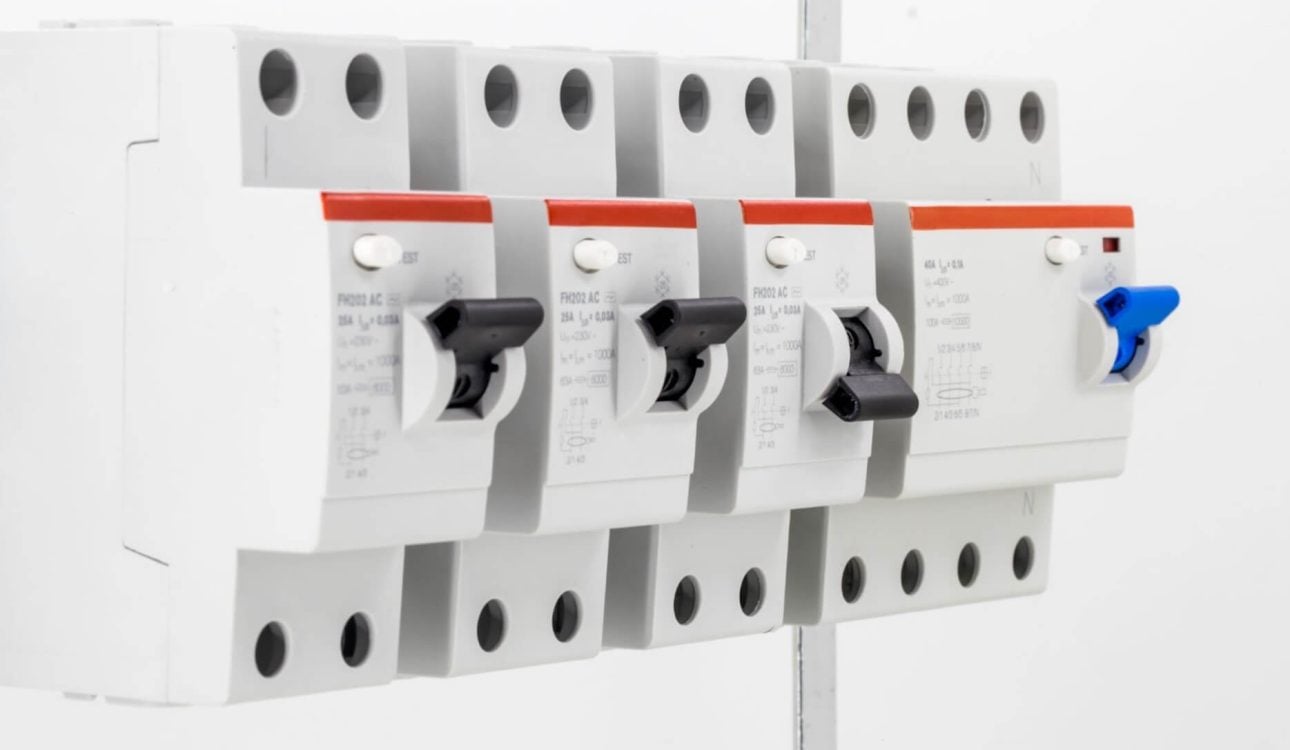

Most UK consumer units installed before 2018 lack surge protection devices (SPDs), leaving electronics vulnerable to damage and fire risks. Upgrading protects your family and expensive electronics.
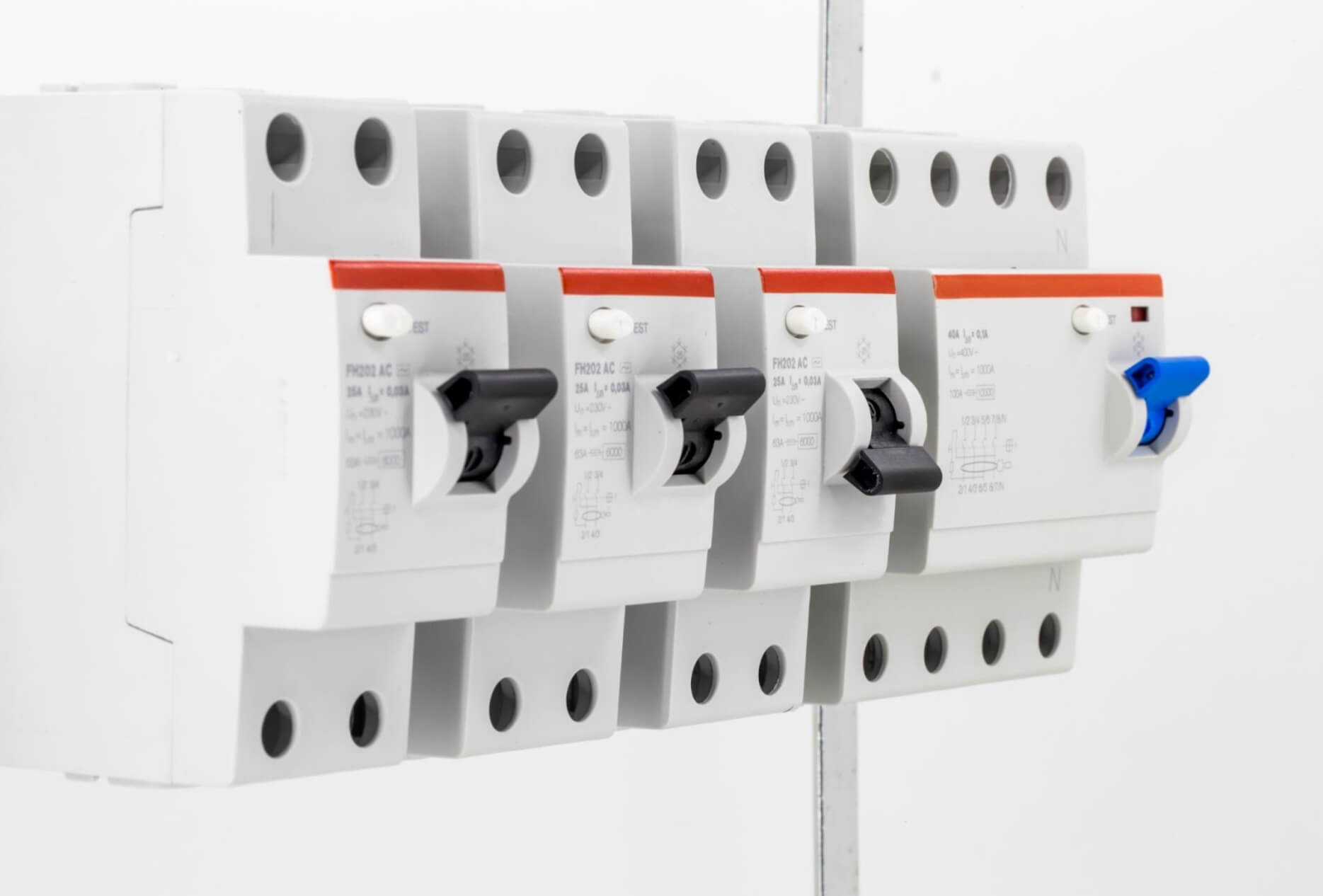
A lot of UK homeowners don’t realise their older consumer units offer zero protection against these transient over voltages. Most consumer units installed before BS 7671 18th Edition regulations were introduced simply weren’t designed to handle modern surge risks, leaving valuable electronics and your home’s wiring completely exposed.
Key Takeaways
- Older fuse boards (pre-2018) lack surge protection devices, exposing homes to equipment damage costing thousands and increased fire risk.
- BS 7671 18th Edition now requires SPDs in new installations, but existing homes remain vulnerable with a serious safety gap.
- Upgrading to a modern consumer unit with integrated SPDs typically costs £400-£800 and protects your home for decades.
The Safety Gap in Older Fuse Boards and Consumer Units
If your fuse board was installed before 2018, there’s a serious safety gap between your electrical system and modern standards. Your wiring might be sound. Your RCDs might work perfectly. But you have zero protection against transient overvoltages.
Power surges happen more often than you think.
What’s Missing from Older Fuse Boards
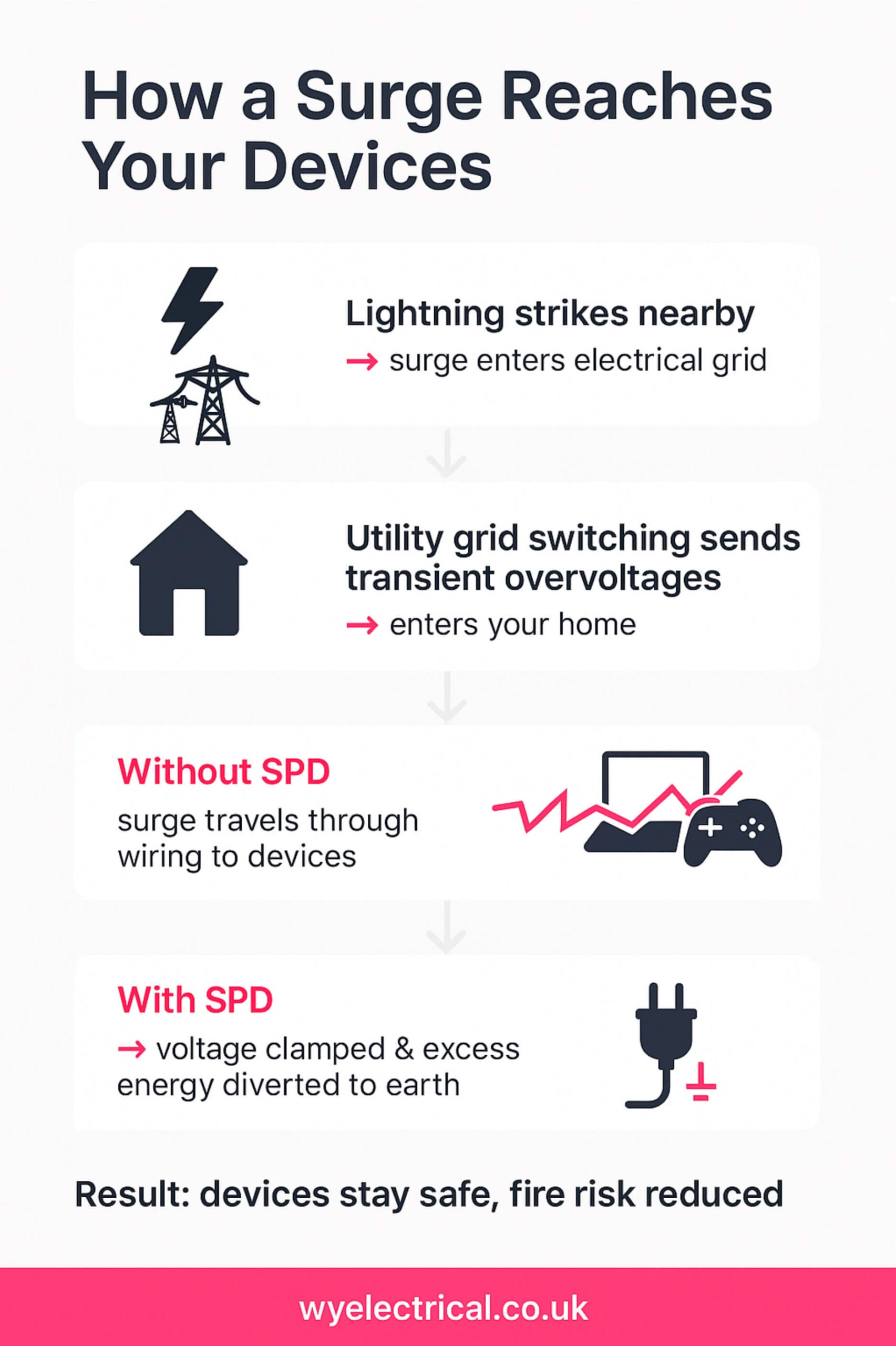
Older consumer units and fuse boards lack SPDs (Surge Protection Devices). These devices clamp dangerous voltage spikes and divert surge energy safely to earth before it reaches your circuits.
Lightning strikes create massive voltage spikes, even when they hit nearby transformers. Grid switching by utility companies sends transient overvoltages through the supply network. Large appliances turning on and off generate localised surges.
Without SPDs, all that surge energy flows straight into your home.
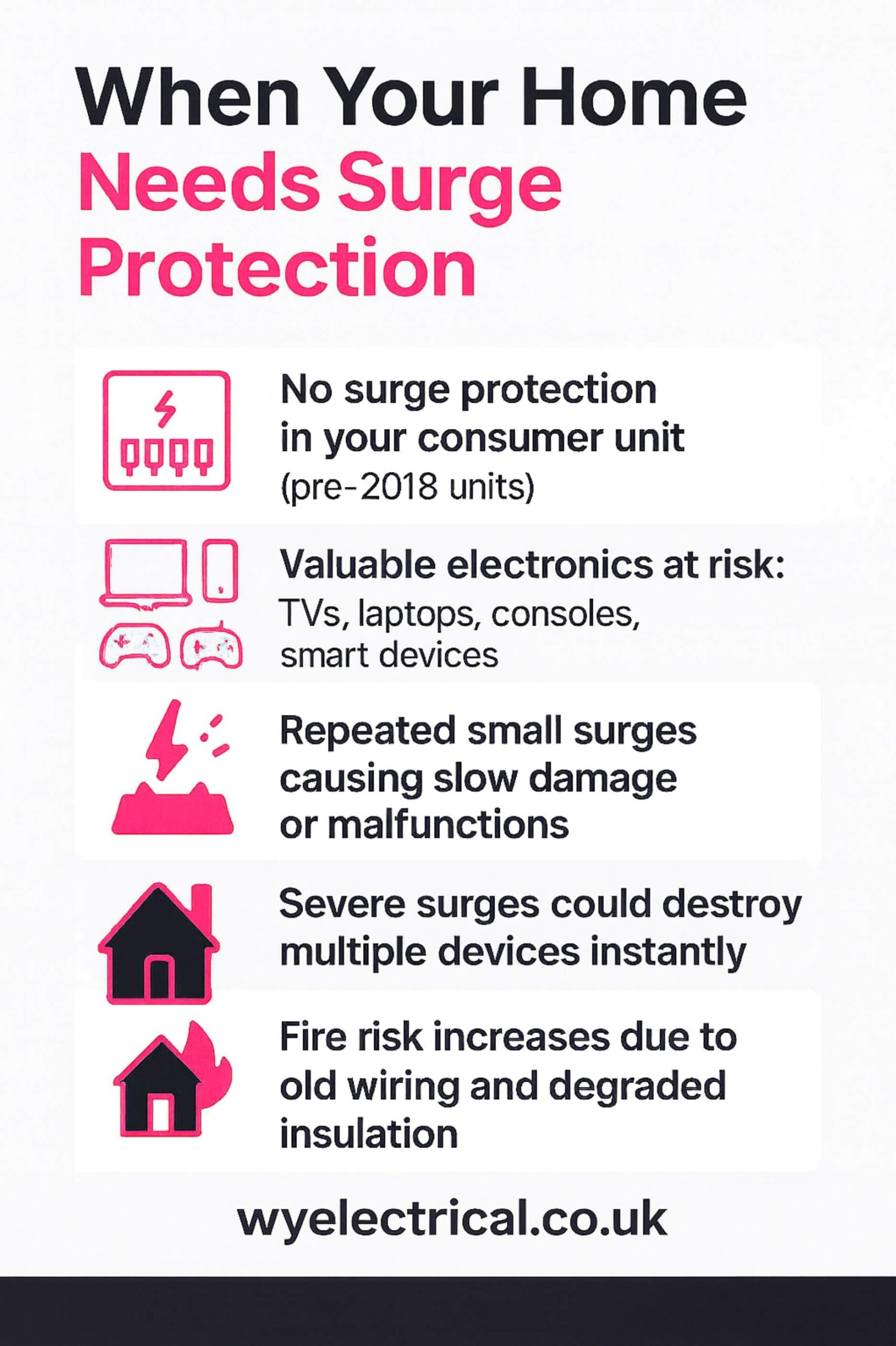
Everything with a circuit board becomes vulnerable. TVs, laptops, gaming consoles, Wi-Fi routers, smart thermostats, kitchen appliances with digital controls. Modern homes are packed with surge-sensitive electronics that older fuse boards were never designed to protect.
Why the Safety Gap Exists
Before 2018, SPDs were optional extras that most electricians skipped.
Then BS 7671 18th Edition changed the game. Amendment 2 (2022) made surge protection mandatory in specific scenarios. Regulation 443.4.1 now requires SPDs where transient overvoltages could cause significant financial loss, data loss, or safety service failure.
New builds must include them. Major renovations must include them.
But existing homes remain grandfathered under old regulations. Your fuse board isn’t illegal. It’s just not protected against risks that modern standards recognise as serious.
| Installation Period | Typical Protection Level | Safety Gap Status |
|---|---|---|
| Before 2000 | No RCDs, no SPDs | Critical safety gap |
| 2000–2015 | Basic RCDs, no SPDs | Moderate safety gap |
| 2015–2018 | Good RCDs, no SPDs | SPD gap only |
| 2018+ | RCDs + SPDs included | Fully protected |
An estimated millions of UK homes still operate with pre-regulation consumer units, leaving electronics and wiring completely exposed. If your fuse board is 20+ years old, it definitely lacks SPDs and probably lacks modern RCD protection too.
What Surge Protection Devices Actually Do for Your Home
Think of SPDs as pressure relief valves for your electrical system.
They monitor incoming voltage constantly. When they detect a dangerous spike, they react in nanoseconds, clamping the voltage to safe levels and diverting excess energy to earth.
How SPDs Protect Your Valuable Electronics
Most UK homes use Type 2 SPDs fitted at the consumer unit, protecting your entire home from a single location. A surge hits. The SPD clamps it. Safe voltage continues to your devices. Your TV keeps playing. Your laptop keeps working.
But SPDs don’t replace other safety devices. RCDs prevent electric shock. MCBs protect against overload. SPDs specifically prevent equipment damage and fire risks from voltage spikes.
They complement each other for comprehensive protection.
What’s Actually at Risk
High-value electronics include smart TVs (£500-£1,000), laptops and PCs (£600-£1,500), gaming consoles (£300-£500). Essential systems like Wi-Fi routers, smart home hubs, security cameras matter too.
Modern appliances with digital controls are surprisingly vulnerable. Boilers, washing machines, ovens, fridges all contain surge-sensitive circuit boards.
Home office setups, NAS drives, broadband equipment round out the list. Losing these costs money, work time, and irreplaceable files.
Real Risks of the Safety Gap
Now we get to the scary part.
A single severe surge can destroy multiple devices instantly. Lightning hits a nearby transformer. The surge destroys your TV (£700), laptop (£900), router (£100), smart home hub (£150), and boiler control board (£300). Total damage: £2,150 from one event.
| Device Type | Typical UK Replacement Cost | Surge Vulnerability Level |
|---|---|---|
| Smart TV | £500–£1,000 | Very High |
| Laptop / Desktop PC | £600–£1,500 | Very High |
| Gaming Console | £300–£500 | High |
| Wi-Fi Router | £80–£150 | High |
| Boiler Control Board | £200–£600 | High |
| Smart Home Hub | £100–£250 | Very High |
| Potential Total Loss | £2,000–£4,000+ | Critical Risk |
Severe surges damage electronics and increase fire risk through arcing and overheating. Recent government statistics show 11,089 domestic electrical fires in England in 2023/24. Old consumer units are especially vulnerable due to degraded insulation and loose connections, making surge events more likely to cause failures, system downtime, or safety hazards.
Data loss, system downtime, and loss of heating or security systems add to the consequences worth preventing.
How to Check If Your Fuse Board Has Surge Protection
Most homeowners have no idea whether their consumer unit includes SPDs.
Modern SPD-equipped boards feature a dedicated SPD module with a status indicator. Green means OK. Red means replace. Check for BS EN 61643-11 marking or “SPD” labelling on the unit. Age provides a reliable rule of thumb. If installed before 2018, it almost certainly lacks SPDs. Rewirable fuse boxes or old Wylex-style boards definitely don’t have surge protection.
The definitive answer comes from booking a professional EICR (Electrical Installation Condition Report). A qualified electrician assesses your consumer unit comprehensively and provides a coded report.
EICR code classifications:
- C1 (Danger Present): Immediate action required. Something poses an immediate risk to safety.
- C2 (Potentially Dangerous): Urgent work needed. The deficiency could become dangerous under certain conditions.
- C3 (Improvement Recommended): Consider an upgrade. Doesn’t meet current best practice, but not immediately dangerous.
Electrical Safety First recommends periodic inspections for all properties, particularly those over 10 years since the last check. For landlords, EICR is legally mandatory every 5 years for private rented properties in England. Understanding what an EICR test involves helps you prepare for the inspection.
Retrofit or Upgrade? Your Options for Adding Surge Protection
Once you know your fuse board lacks SPDs, you face a choice.
Option 1: Retrofit SPD to Existing Fuse Board
If your consumer unit is relatively modern (post-2008), has physical space, and is otherwise sound, a standalone Type 2 SPD can sometimes be added. Cost runs typically £150 to £300, including parts, installation, and testing. But your existing fuse board must meet safety standards. It needs adequate RCD protection and can’t have C1 or C2 faults. Retrofit suits newer consumer units (10-15 years old) that just lack SPDs but are otherwise compliant.
Option 2: Full Consumer Unit Upgrade
If your fuse board is 20+ years old, lacks RCD protection, shows wear, or has C1/C2 issues, a full upgrade is recommended. Cost ranges from £400 to £800, depending on property size.
You get complete replacement with integrated Type 2 SPD, dual-RCD or full RCBO protection, updated MCBs, proper labelling, and full certification. The benefits go beyond surge protection. You solve multiple safety issues simultaneously and future-proof your electrical system for 20+ years.
We assess existing fuse boards honestly and recommend retrofit only when genuinely safe and cost-effective. There are clear signs that indicate when to upgrade your consumer unit, and age is only one factor.
Conclusion
If your fuse board lacks surge protection, there’s a serious safety gap between your home and modern electrical standards. Equipment damage can cost thousands. Fire risks increase with worn components. All preventable.
The solution is straightforward. Retrofit an SPD for £150-£300, or full replacement for £400-£800. One day of installation. Twenty-plus years of protection.
Don’t leave your valuable electronics exposed. We specialise in closing the surge protection safety gap across West Yorkshire with clear advice and quality workmanship.
Get your free quote for consumer unit replacement today. All our work is certified to current wiring regulations and backed by our workmanship guarantee.
FAQs
Do all new consumer units come with surge protection built in?
Not automatically. While BS 7671 now requires SPDs in many scenarios, some budget installations still skip them. Always explicitly request SPD inclusion when getting quotes.
Can I just use plug-in surge protectors instead of upgrading my fuse board?
Plug-in protectors offer limited, point-of-use protection. They don’t protect hardwired circuits like lighting or boiler controls. Whole-home SPDs at the consumer unit provide comprehensive protection for your entire installation. Use both for maximum safety.
How much does it cost to add surge protection to my fuse board?
Retrofit SPD installation runs £150-£300. Full consumer unit replacement with integrated SPD ranges from £400-£800. We provide free quotes based on your specific setup.
Are landlords legally required to install surge protection?
Not explicitly, but landlords must ensure installations are safe and meet current standards. If an EICR identifies lack of surge protection as a significant risk, remedial work may be required. The 5-year EICR is mandatory for private rented properties in England.
Will surge protection stop power cuts or fix all electrical problems?
No. SPDs specifically protect against transient overvoltages. They won’t prevent power cuts, fix faulty appliances, or stop RCD trips from earth leakage. They’re one critical layer in a comprehensive safety system.
