

Many driveway EV chargers in England fall under permitted development, so planning permission is usually unnecessary. Lawful off-street parking and permitted development limits still apply to the installation process.
England driveway EV charger rules are straightforward for many homeowners, but planning permission is only one part of the installation. Many driveway chargers use permitted development rights. The 2025 changes also relaxed key siting limits. Property designations can still affect those rights. Electrical safety, Building Regulations and DNO requirements remain separate checks before any new home charger is installed safely.
Key Takeaways
- Many driveway chargers use permitted development rights when the property has lawful off-street parking, and the installation meets the required limits.
- The May 2025 changes removed the 2 metre highway restriction for qualifying wall-mounted chargepoints under Class D.
- Listed buildings and protected locations can have extra restrictions, so the same planning route does not apply to every property.
- Electrical compliance still applies when planning permission is unnecessary, including smart charging, BS 7671, Building Regulations and DNO notification.
Do You Need Planning Permission for a Driveway EV Charger?
You do not need a separate planning application for a driveway EV charger in England when the installation meets the permitted development conditions. Class D under Part 2 of Schedule 2 to the General Permitted Development Order covers wall-mounted electrical outlets for vehicle charging.
The parking area must be lawfully used for off-street parking. The outlet or casing must not exceed 0.2m³. The installation must also be outside a scheduled monument and cannot sit within the curtilage of a listed building.
The rules for protected areas can differ too. Conservation areas, National Parks, Areas of Outstanding Natural Beauty and World Heritage Sites can retain permitted development rights, but a wall-mounted unit must not face the highway in these locations.
The highway restriction changed in May 2025. A qualifying Class D outlet can now face a highway or sit within 2 metres of one.
What EV Charger Planning Rules Changed in 2025 (And Why It Matters for 2026)
England changed its permitted development rules for EV charging on 29 May 2025. The changes affected Part 2 of Schedule 2 to the General Permitted Development Order.
The first change removed the old rule that stopped a Class D wall mounted outlet from facing a highway or being installed within 2 metres of one. The second raised the permitted height for a Class E electrical upstand from 2.3 metres to 2.7 metres in the relevant cases.
The Department for Transport confirmed these changes in its official UK guidance on EV charging permitted development changes. The updated rules give qualifying installations greater flexibility around charger position and equipment height.
These are planning changes only. They do not remove electrical safety duties or the need for a compliant installation.
In 2026, the updated limits give homeowners more flexibility when choosing where a driveway charger can go.
What EV Charger Rules Apply to Protected Properties?
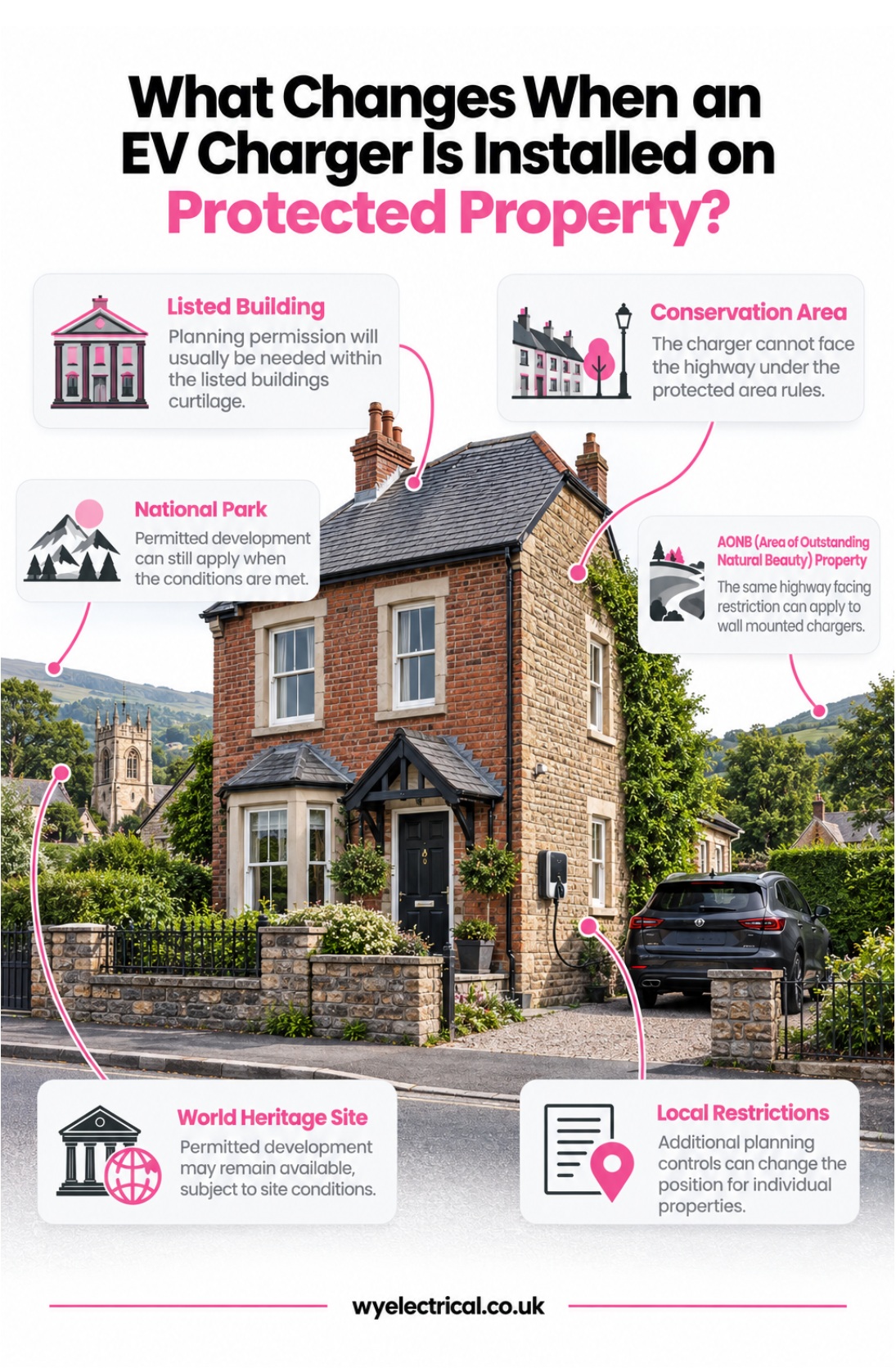
Property designation can change how permitted development applies to a driveway EV charger. Listed buildings have a stricter position, while several other protected areas can still retain permitted development rights subject to specific conditions.
Listed Building Curtilage
Permitted development does not apply to a charger installed within the curtilage of a listed building. Planning permission will usually be required.
Listed building consent may also be needed where the charger or related groundwork affects the listed building or its protected setting. The exact position depends on the property and proposed work.
Conservation Areas
A charger can still benefit from permitted development in a conservation area. There is an important restriction, though. A wall mounted charger must not face the highway.
The conservation area status alone does not mean every driveway charger needs a planning application. The property and charger position still need checking against the applicable rules.
National Parks and Areas of Outstanding Natural Beauty
National Parks and Areas of Outstanding Natural Beauty can still retain permitted development rights for driveway chargers. The same highway facing restriction can apply to wall mounted units.
Local planning controls can also affect an individual property. The exact designation should therefore be checked before the charger position is finalised.
World Heritage Sites
A World Heritage Site does not automatically mean planning permission is required for every driveway charger. Permitted development can still apply, subject to the protected land conditions.
A wall mounted charger must not face the highway. The site designation and charger position should be checked before installation.
What Happens If Your Home Has No Driveway?
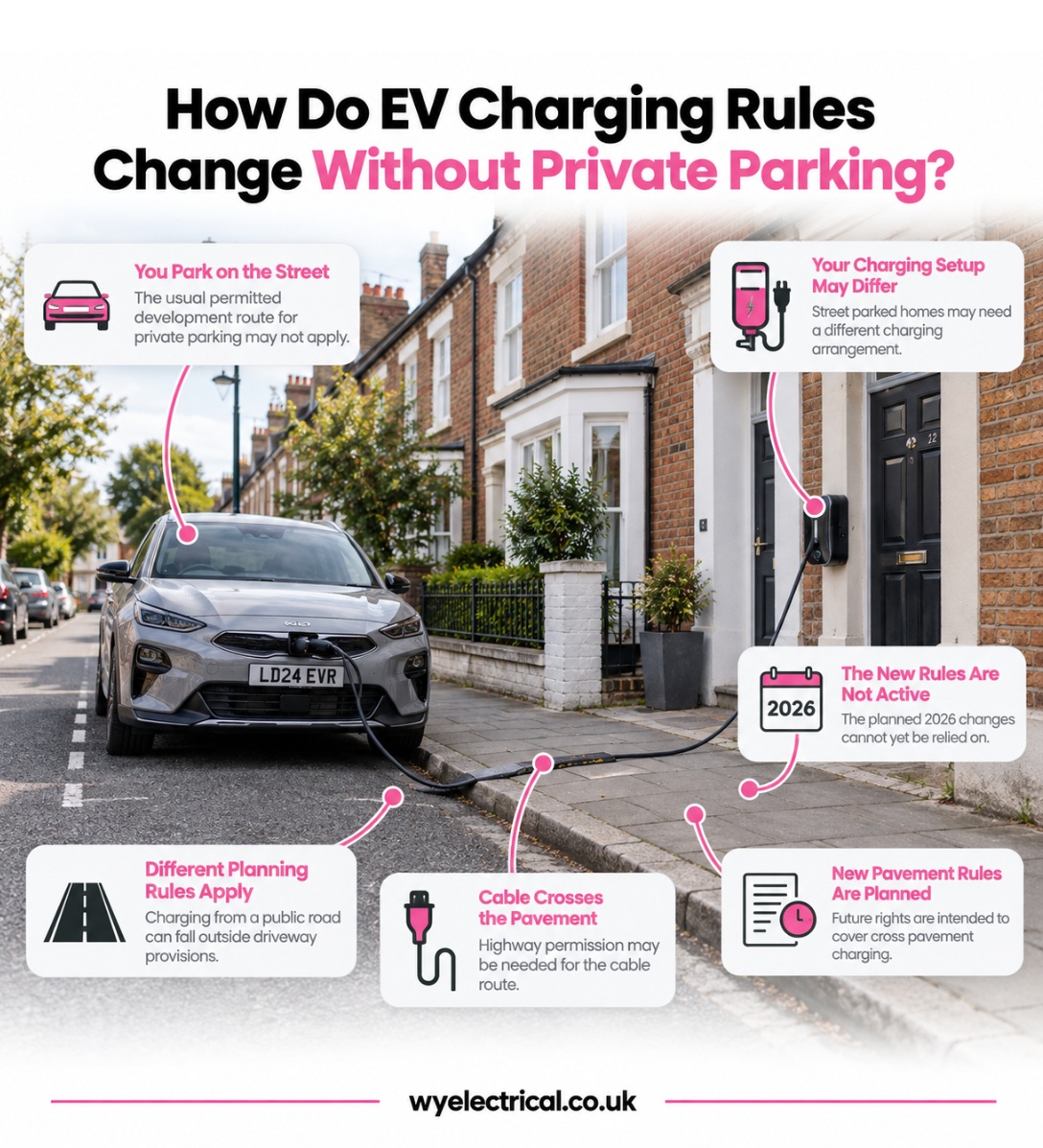
Permitted development for a domestic EV chargepoint applies to land lawfully used for off street parking. That creates a different position for homes that rely on on-street parking.
The Scale of the Driveway Divide
Around 32% of households in England do not have access to off street parking, such as a driveway, garage or residential car park.
The House of Commons Library cites English Housing Survey data showing that around one third of English households lack off street parking.
That creates a clear problem for home charging. The normal permitted development rules for a driveway charger only apply where the land is lawfully used for off street parking. Around one third of households therefore need a different charging arrangement.
Cross Pavement Charging (What’s Changing)
Homeowners who park on the street currently face extra requirements if a charging cable needs to cross a pavement. Permission under the Highways Act 1980 may be needed for the highway works, alongside any street works requirements.
There is a change coming in 2026. On 8 September 2026, the Department for Transport confirmed the planned change in a UK Parliament statement. The new permitted development right will cover cross pavement charging solutions and associated domestic EV chargepoints.
The secondary legislation is expected in autumn 2026. It is not yet in force, so homeowners cannot currently rely on the new permitted development right.
Regional Variation in Off Street Parking
Off street parking access varies across Britain. RAC Foundation research found that 68% of households in England have, or could have, enough off street parking for at least one vehicle.
The figure reaches 75% in Wales, compared with 63% in Scotland and 44% in London. These differences show why access to a driveway varies significantly by location.
This matters because the driveway planning route only helps households that can lawfully use off street parking.
What Technical Requirements Apply to EV Charger Installation?
Planning permission and electrical compliance are separate requirements. A driveway charger can fall under permitted development while still needing to meet UK electrical rules.
Smart Charging Requirements
New domestic EV chargepoints in Great Britain must meet the Electric Vehicles (Smart Charge Points) Regulations 2021. These rules have applied to new chargepoints since 30 June 2022.
The charger needs smart functionality, required cyber security features and default settings that restrict charging during certain peak periods. A new domestic installation therefore cannot use a standard non smart charger.
BS 7671 and Building Regulations
The electrical installation must follow BS 7671 and the IET requirements for EV charging equipment. OZEV guidance also states that chargepoint installations must follow BS 7671, the IET Code of Practice and relevant building regulations.
Adding a new dedicated circuit is normally notifiable electrical work in England. A competent person scheme installer, such as NICEIC or NAPIT, can usually self certify the work instead of the homeowner making a separate building control application.
A professional home EV charger installation service can assess the charger location, electrical supply and protection before the installation goes ahead.
DNO Notification Requirements
The charger adds electrical demand to the property. The local Distribution Network Operator, or DNO, needs to be notified so it can confirm that the network can support the additional load.
This is normally handled by the installer as part of the installation process. The homeowner does not usually need to contact the DNO separately.
When Should You Consult a Professional Installer?
You should consult a professional installer before buying or fitting the charger. This gives you a chance to confirm that the property and proposed charger position meet the current planning rules.
The installer can check whether the property has lawful off street parking. They can also identify listed building status or protected area restrictions that could affect permitted development rights.
The electrical side needs checking too. The charger must meet current smart charging rules, while the existing installation needs to support the new load safely.
A registered installer can also handle Building Regulations notification and DNO liaison. This helps make sure the planning and electrical requirements are dealt with together.
FAQs
Do I need planning permission for a driveway EV charger in England?
Usually no, provided the charger meets the permitted development conditions and the property has lawful off street parking.
What changed in the EV charger planning rules in 2025?
The 2 metre highway restriction for qualifying Class D wall mounted outlets was removed. The Class E upstand height limit also increased from 2.3 metres to 2.7 metres in relevant cases.
Can I install an EV charger if I live in a listed building?
You may need planning permission because permitted development does not cover chargers inside the curtilage of a listed building. Listed building consent may also be required.
What if I do not have a driveway or off street parking?
The normal permitted development route does not apply. Cross pavement charging rules are changing, but the new permitted development right is not yet in force as of September 2026.
Is a dumb EV charger still allowed to be installed?
No. New domestic chargepoints sold for installation in Great Britain must meet the smart charging requirements that have applied since June 2022.
Does my EV charger installation need to be notified to Building Control?
A new dedicated circuit is normally notifiable electrical work in England. A competent person scheme installer can usually self certify the work.
Are there still grants available for home EV chargers?
Yes. Grants remain available for eligible renters, flat owners and households that use on street parking. Funding for these schemes is confirmed until 31 March 2027.
Conclusion
Many driveway EV chargers in England use permitted development rights, but property status and siting conditions still matter. The 2025 changes removed key restrictions. Electrical compliance remains separate. Homes lacking off street parking face different rules, while new cross pavement rights are expected later in 2026.
Thinking about installing an EV charger on your driveway? Get in touch for expert advice and a free quote.
