


Electric car charging times vary by model and method: 10-30 minutes for DC fast charging, 6-10 hours on home chargers, and 20+ hours via standard outlets, depending on battery size and capacity.

One of the most common questions about electric vehicles isn’t about range or cost, but simply how long it takes to charge them. The answer isn’t very simple. Just like petrol cars have different-sized tanks, EVs have various battery sizes, charging capabilities, and access to different charging speeds.
This comprehensive guide unpacks electric car charging time across different models, charging types, and scenarios to help you understand what to expect, whether you’re charging at home or on the go.
Key Takeaways
- Charging speed depends on multiple factors: battery size, vehicle capability, charger type, and temperature, with most EVs reaching 80% in 18-60 minutes on rapid chargers.
- Home charging (7.4kW) typically takes 6-10 hours for a full charge, making overnight charging ideal for daily use, while public rapid chargers are best for long journeys.
- Modern EVs with 800V architecture, like the Kia EV6 and Porsche Taycan, offer the fastest charging times, reaching 80% capacity in under 25 minutes.
What Affects Electric Car Charging Time?
Several key factors determine how long your EV battery’s charging time will be. First and foremost is battery capacity, measured in kilowatt-hours (kWh). Think of this like the size of your “fuel tank” – the larger it is, the longer it takes to fill.
Your vehicle’s maximum charging acceptance rate also matters significantly. Some cars can accept only 50kW while others handle 250kW or more, dramatically affecting charging speed.
The charger type and power output are equally important. A simple home socket delivers much less power than a dedicated wall charger or public rapid charger.
State of charge makes a difference too. Charging slows considerably above 80% battery capacity, which is why many EV drivers only charge to 80% when using rapid chargers.
Environmental factors like temperature can’t be ignored. Cold weather can increase charging time by 30-40%, particularly when using rapid chargers.
The UK charging time formula provides a useful rule of thumb: Time (hours) ≈ Energy needed (kWh) ÷ Charger power (kW)
For example, adding 40kWh using a 7.4kW home charger would take approximately 5.4 hours. Real-world times vary based on the factors mentioned above.

Level 1 vs Level 2 vs DC Fast Charging Speed
Understanding the different charging levels helps you plan how and where to charge your electric vehicle.
Level 1 Charging Duration
Level 1 charging uses a standard home socket (3-pin plug in the UK). This is the slowest charging method, typically delivering only 2.3kW.
At this rate, you’ll gain approximately 2-5 miles of range per hour of charging. For a typical electric car with a 60kWh battery, a full charge from empty could take 20-30 hours.
This option works best as an occasional backup rather than your primary charging method. It’s suitable for plug-in hybrids with smaller batteries, but less practical for fully electric vehicles.
Level 2 Charger Charging Time
Level 2 chargers, which include home wall boxes and many public chargers, deliver significantly faster charging. In the UK, home chargers typically provide 7.4kW of power, while some public units offer up to 22kW.
A 7.4kW home charger adds about 25-30 miles of range per hour. This means most EVs can fully charge overnight in 6-10 hours, making it perfect for home use.
DC Fast Charging Speed
DC fast charging represents the quickest way to charge an EV. These chargers bypass the car’s onboard charger and deliver DC power directly to the battery.
Rapid chargers (50-149kW) can charge most EVs from 10% to 80% in 30-60 minutes. Ultra-rapid chargers (150kW+) can reduce this to just 18-30 minutes for compatible vehicles.
As of January 2025, the UK had 14,448 rapid chargers (20% of all public charging devices), with many located along major travel routes.
Remember that charging speed tapers significantly above 80% battery level, which is why most manufacturers quote 10-80% charging times rather than 0-100%.
Home EV Charging Time vs Public Stations
Home charging and public charging serve different purposes in the EV ecosystem, each with distinct advantages.
Home charging typically happens overnight when your car sits unused for 8+ hours. Most UK homes can support 7.4kW single-phase chargers, adding about 25-30 miles of range per hour. This means a typical 60kWh electric car charges fully overnight, perfect for daily commuting.
The UK’s Electric Vehicles (Smart Charge Points) Regulations 2021 now require home chargers to include smart scheduling features. These automatically shift charging to off-peak hours, saving money without extending actual charging duration.
Public charging comes in various speeds, serving different needs:
| Charging Type | Power Output | Typical Location | Best Use Case |
|---|---|---|---|
| AC Slow/Fast | 3-22kW | Shopping centres, car parks | Destination charging (2-6 hours) |
| DC Rapid | 50-149kW | Service stations, dedicated hubs | En-route charging (30-60 minutes) |
| DC Ultra-Rapid | 150kW+ | Major highways, charging hubs | Minimal-stop long journeys (15-30 minutes) |
The convenience-speed tradeoff is clear: home charging wins for convenience and cost, while public rapid charging excels for speed during journeys. Most EV owners adopt a mixed approach, charging at home for daily use and using rapid chargers only for longer trips.
Popular EV Models and Their Charging Times
Below is a comparison table of charging times for popular electric vehicles across different charging speeds:
| Model | Connector Type | Electric-Only Range (WLTP) | Home Charging | Home Charge Time | Public AC Charging | Public AC Charge Time | Rapid/DC Charging |
|---|---|---|---|---|---|---|---|
| Tesla Model 3 | Type 2 / CCS | ~330–360 mi | Supported (AC) | ~11 h | Supported (AC) | ~7 h | ~25–30 min (80%) |
| Tesla Model Y | Type 2 / CCS | ~331 mi | Supported (AC) | ~12 h | Supported (AC) | ~8 h | ~20 min (80%) |
| Tesla Model S | Type 2 / CCS | ~283–405 mi | Supported (AC) | ~11–15 h | Supported (AC) | ~5–6 h | ~30–60 min |
| Tesla Model X | Type 2 / CCS | ~358 mi | Supported (AC) | ~10 h | Supported (AC) | ~10 h | ~30 min (80%) |
| Kia EV6 | Type 2 / CCS | ~313 mi | Supported (AC) | ~7–8 h | Supported (AC) | ~7 h | ~18 min (80%) |
| Hyundai Ioniq 5 | Type 2 / CCS | ~238–300 mi | Supported (AC) | ~9 h | Supported (AC) | ~6–7 h | ~20–50 min (80%) |
| Nissan Leaf (2018) | Type 2 / CHAdeMO | ~168 mi | Supported (AC) | ~6 h | Supported (AC) | ~6 h | ~40 min (80%) |
| Nissan Leaf e+ (2019) | Type 2 / CHAdeMO | ~239 mi | Supported (AC) | ~10 h | Supported (AC) | ~10 h | ~30–50 min (80%) |
| Audi e-tron 55 | Type 2 / CCS | ~249 mi | Supported (AC) | ~14 h | Supported (AC) | ~9 h | ~30–70 min (80%) |
| Audi Q8 e-tron | Type 2 / CCS | ~285 mi | Supported (AC) | ~8.5 h | Supported (AC) | ~4–5 h | ~30 min (80%) |
| Polestar 2 | Type 2 / CCS | ~292 mi | Supported (AC) | ~11–12 h | Supported (AC) | ~11–12 h | ~28–35 min (80%) |
| Volvo XC40 Recharge | Type 2 / CCS | ~260–270 mi | Supported (AC) | ~11 h | Supported (AC) | ~7 h | ~37–40 min (80%) |
| Jaguar I-PACE | Type 2 / CCS | ~292 mi | Supported (AC) | ~10 h | Supported (AC) | ~10 h | ~45–85 min (80%) |
| BMW iX | Type 2 / CCS | ~230–340 mi | Supported (AC) | ~11 h | Supported (AC) | ~5–6 h | <40 min (80%) |
| VW ID.5 | Type 2 / CCS | ~266–331 mi | Supported (AC) | ~12 h | Supported (AC) | ~8–12 h | ~28–90 min |
| Lucid Air | Type 2 / CCS | ~410–520 mi | Supported (AC) | ~13 h | Supported (AC) | ~9 h | ~20 min (80%) |
| Ford Mustang Mach-E | Type 2 / CCS | ~250–379 mi | Supported (AC) | ~10 h | Supported (AC) | ~7 h | ~38 min (80%) |
| Chevrolet Bolt EV | Type 1 (US) / CCS | ~259 mi | Supported (AC) | ~10 h | Supported (AC) | ~7 h | ~30–60 min |
| Honda e | Type 2 / CCS | ~137 mi | Supported (AC) | ~6 h | Supported (AC) | ~4 h | ~30 min (80%) |
| Mini Electric (Cooper SE) | Type 2 / CCS | ~145 mi | Supported (AC) | ~6 h | Supported (AC) | ~4 h | ~35 min (80%) |
| Fiat 500 Electric | Type 2 / CCS | ~118–199 mi | Supported (AC) | ~6 h | Supported (AC) | ~4 h | ~30–35 min (80%) |
| Peugeot e-208 | Type 2 / CCS | ~225 mi | Supported (AC) | ~7.5 h | Supported (AC) | ~5 h | ~30 min (80%) |
| Vauxhall Corsa-e | Type 2 / CCS | ~222 mi | Supported (AC) | ~7.5 h | Supported (AC) | ~5 h | ~30 min (80%) |
| Renault Zoe ZE50 | Type 2 / CCS (later) | ~245 mi | Supported (AC) | ~9 h | Supported (AC) | ~6 h | Some versions not supported |
| Citroën ë-C4 | Type 2 / CCS | ~217 mi | Supported (AC) | ~7.5 h | Supported (AC) | ~5 h | ~30 min (80%) |
| Skoda Enyaq iV | Type 2 / CCS | ~260–333 mi | Supported (AC) | ~9–10 h | Supported (AC) | ~6–7 h | ~35 min (80%) |
| SEAT Mii Electric | Type 2 / CCS | ~160 mi | Supported (AC) | ~6 h | Supported (AC) | ~4 h | ~40 min (80%) |
| Dacia Spring Electric | Type 2 / CCS | ~143 mi | Supported (AC) | ~14 h | Supported (AC) | ~8 h | Some versions not supported |
| Mercedes EQS | Type 2 / CCS | ~453–485 mi | Supported (AC) | ~11 h | Supported (AC) | ~6 h | ~31 min (80%) |
| Porsche Taycan | Type 2 / CCS | ~246–318 mi | Supported (AC) | ~9 h | Supported (AC) | ~6 h | ~22 min (80%) |
Times represent charging from near-empty to full for home charging, and 10-80% for rapid charging, as this is the typical usage pattern for fast chargers.
Fastest-Charging EVs in 2025
The race for faster charging continues to accelerate. These models lead the pack in 2025:
- Kia EV6 – Can charge from 10-80% in just 18 minutes on a 350kW charger
- Hyundai Ioniq 6 – Matches the EV6 with an 18-minute 10-80% charge time
- Kia EV9 – Despite its massive 99.8kWh battery, achieves 10-80% in 24 minutes
- Porsche Taycan – Charges from 10-80% in about 22 minutes
- Lucid Air – With its 900V architecture, charges at some of the highest rates available
The fastest-charging EVs now use 800V or 900V electrical architecture instead of the more common 400V systems, allowing for much higher charging rates while minimising heat buildup.
Smart Tips to Reduce EV Charging Time
You can significantly improve your electric car’s charging experience with the following practical strategies.
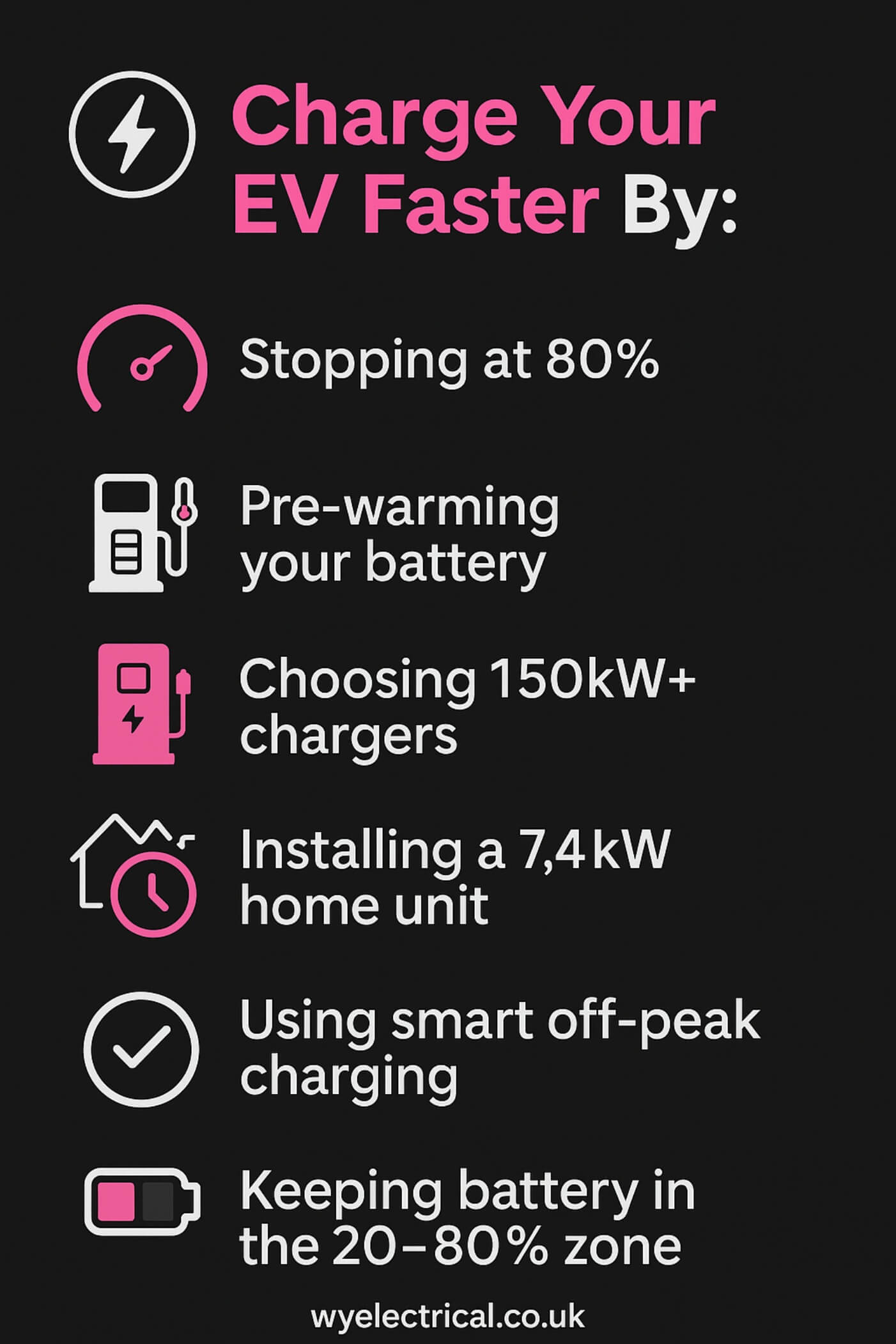
Focus on the 10-80% charging window for maximum efficiency. Charging slows dramatically above 80%, so save time by stopping at this level during journeys.
Precondition your battery before rapid charging whenever possible. Many EVs allow you to warm the battery to optimal temperature through the app when navigating to a charger.
Plan long journeys around ultra-rapid chargers. Use apps to find chargers rated 150kW or higher if your vehicle supports these speeds.
Install a 7.4kW home charger rather than relying on a 3-pin socket. This investment can reduce charging times by 70% compared to standard socket charging.
Take advantage of smart charging features. Modern chargers can automatically charge during off-peak hours, saving money without affecting total charging time.
Consider your battery management. Keeping your battery between 20-80% for daily use not only speeds up charging but also preserves battery health.
Conclusion
For most drivers, home charging overnight easily meets daily driving needs, while occasional rapid charging makes longer journeys perfectly practical.
Need help setting up efficient home charging? Contact our certified EV charging installation specialists to find the perfect charging solution for your electric vehicle. We’ll ensure your home is ready for faster, smarter EV charging with installations that meet all UK regulations.
Frequently Asked Questions
How long does it take to charge an electric car at home?
Using a 7.4kW home charger, most electric cars take 6-10 hours to charge fully. This makes overnight charging perfect for most users. A standard 3-pin socket is much slower, taking 20-30 hours for a full charge.
Do bigger EV batteries take longer to charge?
Yes, larger batteries require more time to charge. However, many larger battery vehicles also accept higher charging rates, which can partially offset the increased capacity.
Is DC fast charging bad for EV batteries?
Occasional DC fast charging is not harmful, but exclusive reliance on rapid charging may accelerate battery degradation over time. For everyday use, home charging is gentler on the battery.
How much does it cost to charge an electric car in the UK?
Home charging costs approximately £10-15 for a full charge (60kWh battery) with standard electricity rates. Off-peak tariffs can reduce this to £5-8. Public rapid charging is more expensive, typically £20-30 for the same amount of energy.
What EV has the fastest charging time in 2025?
The Kia EV6, Hyundai Ioniq 6, and Porsche Taycan lead the pack with 10-80% charging times of approximately 18-22 minutes on 350kW chargers.
