
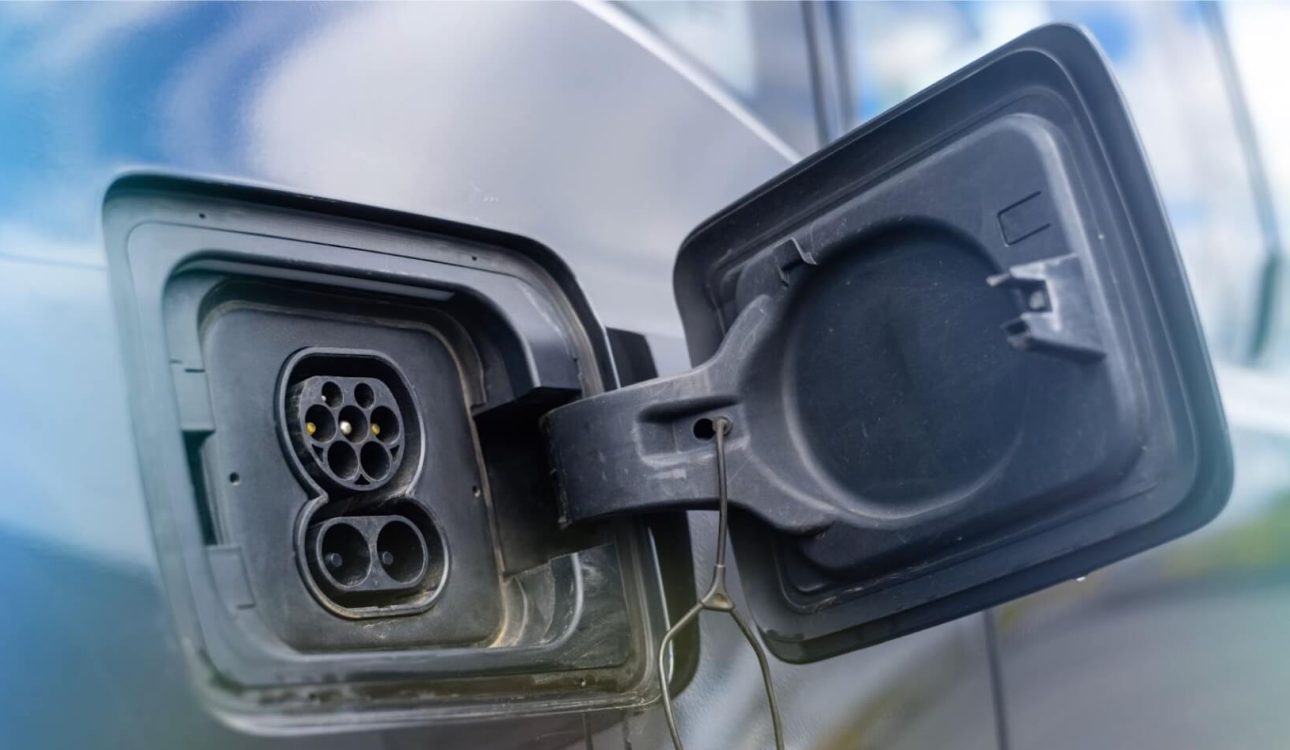

EV charging connectors vary by type (Type 1, Type 2, CCS, CHAdeMO), charging speed (AC/DC), and vehicle compatibility. This guide explains all options to help you understand which connectors work with your electric vehicle.

Electric vehicle charging involves a variety of connectors and sockets that can seem overwhelming at first. Each type serves a specific purpose and works with different vehicles. This guide breaks down everything you need to know about EV charging sockets and connector types in the UK, from the basics to the technical details.
Key Takeaways:
- Most modern EVs in the UK use Type 2 connectors for AC charging (3.7-22kW) and CCS for rapid DC charging (50-350kW).
- Charging speed depends on connector type; AC charging takes hours while DC rapid charging can reach 80% battery in 15-30 minutes.
- UK regulations now require public chargers to offer Type 2 sockets for AC and CCS for DC charging, creating more standardisation across the charging network.
What Are EV Charging Connectors and Sockets?
Charging connectors are the physical plugs that transfer electricity from a charging point to your electric vehicle. Think of them as specialised power plugs designed to handle the high voltages and currents needed for EV charging while maintaining safety.
The connector is the part you hold in your hand, while the socket is where it plugs in, either on the charging unit (charger-side socket) or on your vehicle (vehicle inlet).
Different connector types handle different charging speeds and currents. Some work only with AC power (alternating current), while others handle DC (direct current) for rapid charging. This variation exists because EVs entered the market before standards were fully established.
Types of EV Charging: AC vs DC
The fundamental difference between AC and DC charging comes down to where the conversion happens.
With AC charging, your car has an onboard converter (called an onboard charger) that transforms the AC electricity from the grid into DC electricity that can be stored in the battery. This onboard charger has power limitations, typically 7-22kW, which is why AC charging is slower.
DC charging bypasses your car’s onboard charger completely. The conversion from AC to DC happens in the charging station itself, which can supply DC power directly to your battery at much higher rates, anywhere from 50kW to 350kW.
That’s why you can charge in minutes rather than hours at a DC charger. Your car’s battery only accepts DC power, so removing the conversion step inside the vehicle allows for these dramatically faster charging speeds.
Common EV Connector Types in the UK
Type 1 Connector (J1772)
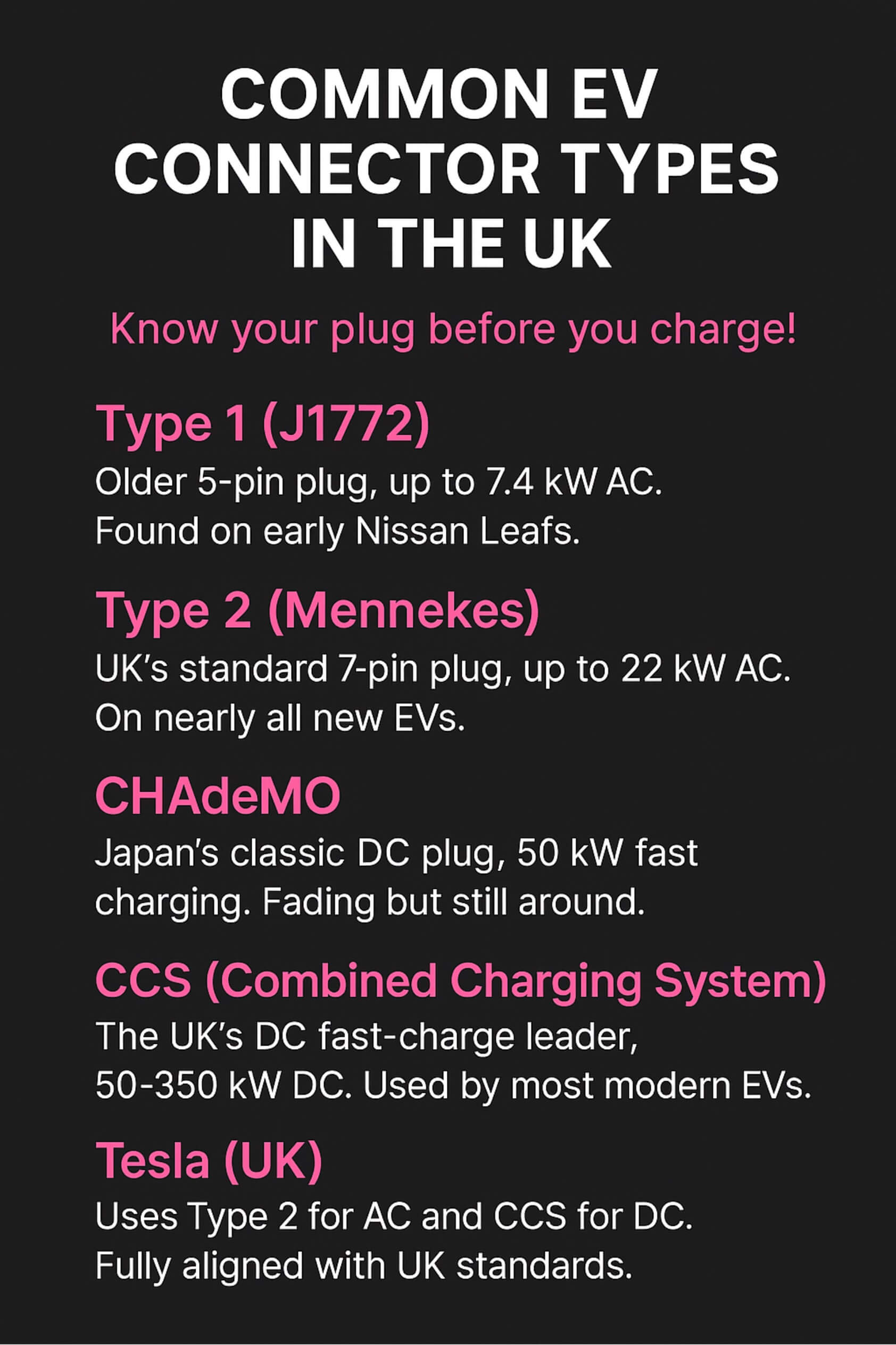
The Type 1 connector is a five-pin plug that handles AC charging up to 7.4kW. Originally from North America and Japan, it’s now considered legacy technology in the UK.
You’ll mostly find Type 1 connectors on older EVs like first-generation Nissan Leafs and some Mitsubishi models. These days, Type 1 is fading out in favour of Type 2 for new vehicles sold in the UK.
If you have a vehicle with a Type 1 inlet, don’t worry, adapter cables let you connect to the more common Type 2 public charge points.
Type 2 Connector (Mennekes)
Type 2 is the standard AC connector across Europe and the UK. This seven-pin connector handles both single-phase and three-phase power, offering more flexibility than Type 1.
It can deliver anywhere from 3.7kW to 22kW in most applications, though technically it supports up to 43kW in rare cases. UK regulations now require all public AC charge points to have at least one Type 2 socket.
Nearly all new EVs sold in Britain come with Type 2 inlets for their AC charging. The connector’s seven-pin design includes communication pins that enable smart charging features.
CHAdeMO Connector
CHAdeMO was the first mainstream DC rapid charging standard, developed in Japan. These chunky connectors can deliver up to 50kW (sometimes 100kW) for fast charging.
While once common, CHAdeMO is now considered legacy technology in the UK. You’ll still find these connectors at older rapid charging stations and on some Japanese vehicles like older Nissan Leafs.
New charging networks are gradually phasing out CHAdeMO in favour of CCS, though many sites maintain both to support existing vehicles.
CCS (Combined Charging System) Connector
CCS has become the dominant DC fast-charging standard in the UK and Europe. The name “Combined Charging System” reflects its design; it’s essentially a Type 2 connector with two additional DC power pins beneath it.
This smart design means vehicles only need one inlet that works for both AC charging (using just the top Type 2 part) and DC rapid charging (using the full connector).
Modern CCS chargers offer speeds from 50kW up to 350kW for ultra-rapid charging. UK regulations now require all new public DC rapid chargers to provide CCS connections.
Tesla Connector (UK context)
Tesla initially used a modified Type 2 connector for both AC and DC charging in Europe and the UK. However, newer Tesla models have transitioned to CCS for rapid charging while maintaining Type 2 for AC charging.
The company’s Supercharger network initially used proprietary connections, but Tesla has been updating many stations to support CCS connectors as well, making them accessible to non-Tesla vehicles in some locations.
This shift reflects the broader industry standardisation around Type 2 and CCS in the UK market.
EV Socket Types (Vehicle Inlet Side)
The socket on your vehicle (the inlet) determines which charging cables you can use. Most modern EVs in the UK come with one of two setups:
- A Type 2 inlet for AC charging only, with a separate CHAdeMO inlet for DC fast charging (found on some Japanese models)
- A Combined Charging System (CCS) inlet that handles both Type 2 AC charging and DC fast charging through the same port
The trend is strongly toward the second option, with CCS becoming the standard on most new EVs sold in Britain since 2019.
Your vehicle’s inlet type is fixed, so it’s important to know which one you have. Most EVs come with a charging cable that matches your inlet type on one end and has a Type 2 connector on the charger end.
UK EV Connector Compatibility Table (2025 Update)
| Vehicle Make/Model | AC Socket | DC Socket | Max AC Speed | Max DC Speed |
|---|---|---|---|---|
| Tesla Model 3/Y | Type 2 | CCS | 11kW | 250kW |
| Tesla Model S/X | Type 2 | CCS | 22kW | 250kW |
| Nissan Leaf (new) | Type 2 | CHAdeMO | 7.4kW | 50kW |
| VW ID.3/ID.4 | Type 2 | CCS | 11kW | 125–135kW |
| Hyundai Ioniq 5 | Type 2 | CCS | 11kW | 220kW |
| Kia EV6 | Type 2 | CCS | 11kW | 240kW |
| BMW i4/iX | Type 2 | CCS | 11kW | 200kW |
| Ford Mustang Mach-E | Type 2 | CCS | 11kW | 150kW |
| MG4 | Type 2 | CCS | 7.4kW | 135kW |
| Renault Zoe | Type 2 | None | 22kW | N/A |
| Older Nissan Leaf | Type 1 | CHAdeMO | 3.6–6.6kW | 50kW |
Home vs Public Charging Connectors
Home charging in the UK typically uses dedicated Mode 3 charging stations with Type 2 sockets. According to Building Regulations Part S, new home installations must provide at least 7kW charging power through an untethered (universal) socket unless there are exceptional circumstances.
When installing an EV charger at home, it’s essential to use an accredited installer who understands the specific electrical requirements and safety standards.
Public charging infrastructure has moved toward standardisation. UK law requires public AC charging stations to provide Type 2 connections, while DC high-power chargers must offer CCS2. This standardisation makes public charging more accessible regardless of your vehicle type.
The key differences lie in charging speeds and payment systems. Home units typically deliver 7kW, while public chargers range from 7kW AC chargers in car parks to 350kW ultra-rapid DC chargers at motorway services.
Home units connect directly to your electricity supply and appear on your home energy bill, while public chargers require apps, RFID cards, or contactless payments. New regulations require all public chargers 8kW and above to offer contactless payment by November 2024.
Rapid and Ultra-Rapid Charging Connectors
Rapid and ultra-rapid charging always uses DC power and comes with tethered cables attached to the charging unit. No need to bring your own cable here.
For rapid charging (50kW), you’ll encounter either:
- CCS connectors (the European standard)
- CHAdeMO connectors (Japanese standard, declining in new installations)
For ultra-rapid charging (100-350kW), almost all new installations use the CCS standard exclusively. These high-power stations can charge compatible vehicles from 10-80% in as little as 15-30 minutes.
Remember that your EV will automatically communicate with the charger to negotiate the maximum safe charging speed, so a 150kW charger will never deliver more power than your car can handle.
Choosing the Right Connector for Your EV
For most UK EV owners, the decision is already made by their vehicle’s built-in inlet type. However, here’s practical advice for different situations:
If you drive a newer EV (2019 onwards), you’ll likely have:
- Type 2 socket for AC charging
- CCS socket for DC rapid charging
This combination covers virtually all UK public charging infrastructure.
For older vehicles with Type 1 and CHAdeMO, keep these tips in mind:
- Carry a Type 1 to Type 2 adapter cable for AC charging
- Use apps like ZapMap to locate CHAdeMO rapid chargers for DC charging
When installing a home charger, an untethered Type 2 socket offers the most flexibility, working with all modern EVs using the appropriate cable.
If buying a new EV, models with CCS capability will give you access to the fastest-growing charging network in the UK, including the expanding ultra-rapid charging infrastructure.
Conclusion
The EV connector landscape continues to standardise around Type 2 for AC and CCS for DC charging in the UK. Understanding your vehicle’s compatibility ensures you can charge confidently at home and on the road.
Ready to install a reliable, future-proof home charging solution? Our experts can help you select and install the perfect charging system for your needs. Contact us today for a free quote on professional EV charger installation.
FAQs
What’s the difference between Type 1 and Type 2 EV connectors?
Type 1 is a 5-pin connector limited to single-phase charging up to 7.4kW, found on older vehicles. Type 2 is a 7-pin European standard that handles both single and three-phase power up to 22kW, now standard on most new EVs in the UK.
Can I use a Type 2 charger on a Type 1 car?
Yes, with an adapter cable that has a Type 2 connector on the charger end and a Type 1 connector on the vehicle end. Most owners of Type 1 vehicles keep this adapter cable in their car.
Are all public chargers compatible with all EVs?
No, but standardisation is improving. All public AC posts in the UK must provide Type 2 sockets, and all rapid DC chargers must offer CCS connections. Older vehicles with CHAdeMO may find fewer compatible rapid chargers as the network evolves.
What connector do Tesla cars use in the UK?
New Tesla models in the UK use Type 2 for AC charging and CCS for DC rapid charging. Older models may use a modified Type 2 connector for both AC and DC charging at Tesla Superchargers.
Can I charge my EV with a regular plug socket?
Yes, but it’s not ideal for regular use. Standard 3-pin outlets deliver around 2.3kW, meaning a full charge takes 15-30 hours for most EVs. Home charging stations deliver 7kW or more, charging 3-6 times faster and with added safety features.
