
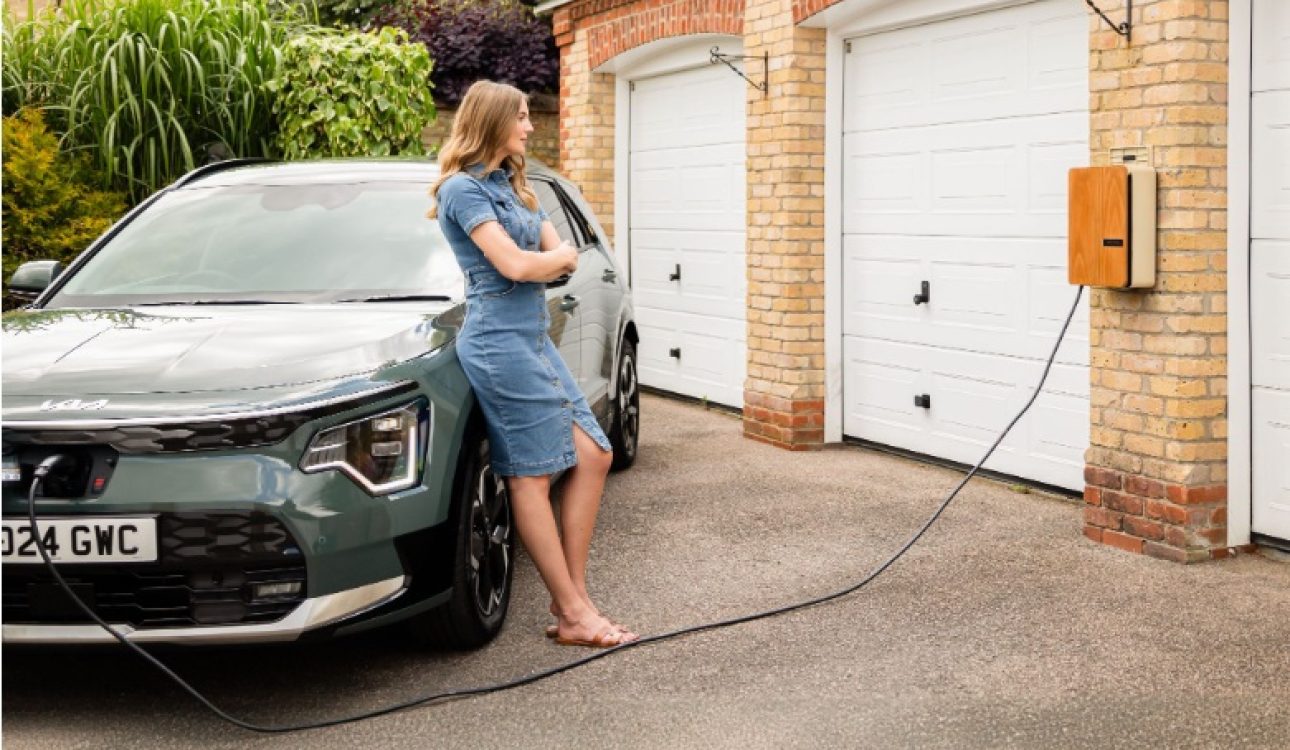

Homeowners with driveways can no longer claim a home EV charger grant. Renters, flat owners, landlords and households without off-street parking may still qualify for up to £500.
A lot of people still think any homeowner can claim government money towards a home EV charger. That stopped being true in 2022. The rules around home EV charger grants in 2026 are much more specific now, and if you apply without checking eligibility first, you could lose the funding entirely.
Key Takeaways
- The original Electric Vehicle Homecharge Scheme (EVHS) closed in 2022 and has not been replaced for standard homeowners with driveways.
- Renters, flat owners, landlords and households with only on-street parking can still claim up to £500 per socket through OZEV grants extended to March 2027.
- You must receive grant approval before installation, not after. Installing first voids your eligibility completely.
Are Home EV Charger Grants Still Available in 2026
Home EV charger grants are far more limited than they were a few years ago. The broad scheme that once helped homeowners install chargepoints has ended, leaving a smaller number of grants aimed at specific groups.
From 1 April 2026, the Office for Zero Emission Vehicles (OZEV) updated its grant schemes by extending selected funding until 31 March 2027 and increasing the maximum contribution from £350 to £500 per socket.
The sections below explain which grants remain available, which have ended and who can still benefit:
What Grants Are Still Available
The latest OZEV EV chargepoint grant guidance on GOV.UK confirms three main routes for home-based applicants in 2026.
EV Chargepoint Grant for Renters and Flat Owners covers eligible renters in any residential property and flat owners, including shared ownership.
If you have private off-street parking, this one applies to you. You can claim 75% of the purchase and installation cost, up to £500 per socket.
EV Chargepoint Grant for Households with On-Street Parking targets homeowners and renters who have no driveway at all. It covers cross-pavement or gully-style charging solutions, again up to £500 per socket.
Uptake has been very low so far, with only 39 sockets funded nationally as of January 2026, so this route is largely untapped.
Residential Landlord Chargepoint Grant is for landlords installing chargers for their tenants, up to £500 per socket and a maximum of 200 sockets per year.
There is also the Workplace Charging Scheme for businesses and charities, though that falls outside the scope of a home setup.
Which Grants Have Ended
The Electric Vehicle Homecharge Scheme, or EVHS, closed in April 2022. It funded over 340,000 installations worth £140.8 million between 2014 and 2022. That chapter is closed. Standard homeowners with a private driveway are no longer eligible under any current scheme.
A lot of outdated information still circulates online claiming EVHS is still available. It is not. If a website tells you otherwise, it has not been updated.
| Grant | Who Can Apply | Maximum Funding | Status |
|---|---|---|---|
| EV Chargepoint Grant for Renters & Flat Owners | Eligible renters and flat owners | Up to £500 | Open |
| On-Street Parking Grant | Eligible households without a driveway | Up to £500 | Open |
| Residential Landlord Grant | Residential landlords | Up to £500 per socket | Open |
| Electric Vehicle Homecharge Scheme (EVHS) | Standard homeowners | N/A | Closed |
Who Can Still Claim a Home EV Charger Grant
Eligibility depends on your living situation, not just your desire to charge at home. The government has focused the remaining grants on people who cannot easily install a charger without support.
Eligible Applicants
Home EV charger grants are now aimed at people who face greater barriers to installing a charger than a typical homeowner with a private driveway. This targeted approach reflects the government’s focus on expanding access to home charging where it is needed most.
According to research from the RAC Foundation, around 35% of British households cannot accommodate off street parking, making home charging more difficult without dedicated support.
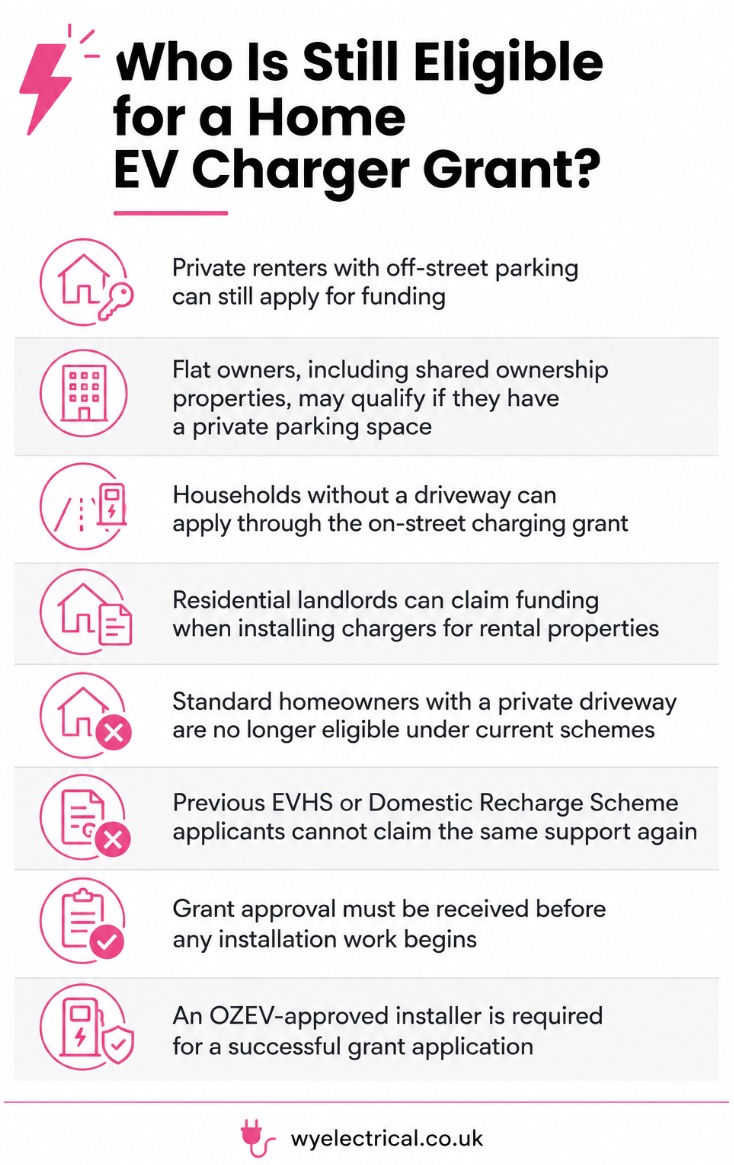
That is why the remaining grant schemes focus on renters, flat owners, landlords and households without a driveway.
UK research on EV charging infrastructure from the UK Energy Research Centre also highlights that improving equitable access to home charging remains an important challenge. This is reflected in today’s more targeted grant schemes.
The infographic below shows who is still eligible for a home EV charger grant in 2026 and the key conditions you need to meet before applying:
If you fall into one of these eligible groups, we can help you choose the right charging solution, check your eligibility and complete a compliant installation from start to finish
As UK research on EV charging infrastructure from the UK Energy Research Centre highlights, equitable access to home charging remains a live issue, and the current grant structure reflects that.
Who Cannot Claim
Standard homeowners with a private driveway cannot claim. That is the most important point to take away from this section.
Beyond that, there are a few other situations that will void your application. Anyone who had a charger installed before receiving grant confirmation is immediately ineligible.
This is one of the most common reasons applications are rejected. Approval must come before installation or you will lose your grant eligibility.
If you have previously claimed under EVHS or the Domestic Recharge Scheme, you cannot claim again. Properties that are legally required to install EV infrastructure under Part S Building Regulations in England (from June 2022) or the equivalent Scottish regulations are also excluded, since the requirement already mandates the install.
How Much Will the Grant Cover
The grant covers 75% of the combined purchase and installation cost, up to a maximum of £500 per socket.
Both the charger and the labour are included. What it does not cover is any work beyond the standard scope, such as major consumer unit upgrades or significant groundworks, which you would pay for separately.
The £500 cap means that if your total cost is lower, the 75% rule applies first. For example, a £400 job would yield a £300 grant. Once you hit the cap, everything above £667 (approximately) is yours to fund.
| Installation Cost | Maximum Grant | Customer Pays |
|---|---|---|
| £600 | £450 | £150 |
| £800 | £500 | £300 |
| £1,000 | £500 | £500 |
One critical point to keep in mind is that grant approval must come before installation. The grant is applied to the final invoice after an approved installation, so installing first means you lose the funding.
How to Apply for an EV Chargepoint Grant
The process is more straightforward than most people expect. Here is exactly how it works:
- Confirm your eligibility using the GOV.UK grant pages for your specific situation (renter, flat owner, landlord, on-street parking).
- Choose an OZEV-approved installer. Only approved installers can submit grant applications on your behalf.
- Submit the grant application through the new application platform introduced on 1 April 2026. The old portal closed to customer applications on 31 March 2026.
- Wait for approval before booking any installation work.
- Arrange the installation once approval is confirmed.
- The installer submits photographic evidence and required documentation as part of the claim process.
- The grant is deducted from your final invoice. You pay only the remaining balance.
Good home EV charger safety guidance from Electrical Safety First confirms that all installations must meet BS 7671 wiring standards and be carried out by a registered electrician. This is not optional.
It is also worth knowing that EV charger installation is notifiable work under Building Regulations. The Part P requirements for EV charger installation from NICEIC explain that a qualified electrician registered with a Competent Person Scheme can self-certify the work, which is the standard route for most domestic installs.
What Does a Home EV Charger Cost Without a Grant?
If you do not qualify for a grant, that does not mean home charging is out of reach.
A typical home EV charger unit costs between £500 and £1,000, depending on the model and features. Installation adds roughly £200 to £500 on top of that for a standard job. Costs go up if you need a longer cable run, a consumer unit upgrade, or groundworks for a cross-pavement solution.
If you want an accurate picture for your property, our home EV charger installation service covers the full range of factors that affect price, and we can give you a straight answer without any guesswork.
Even at full cost, home charging is considerably cheaper per mile than using public charge points. Smart EV tariffs offered by several energy suppliers can bring the cost down further by charging overnight when rates are lower.
Is Installing a Home EV Charger Still Worth It in 2026
Government funding can certainly reduce the upfront cost, but it is only one factor when deciding whether to install a home EV charger.
Charging at home is far more convenient than relying on public charging points. There is no waiting for an available charger or planning journeys around charging stops. Instead, you can plug in overnight and start each day with a fully charged battery.
Home charging is also significantly cheaper than using many public chargers. Even on a standard electricity tariff, many EV drivers spend less by charging at home. Switching to an off peak smart tariff can reduce those costs even further.
There is also a long term benefit to consider. As electric vehicles become more common, a home EV charger can make a property more appealing to future buyers or tenants.
Whether or not you qualify for a grant, installing a charger can still be a worthwhile investment.
FAQs
Can homeowners still get an EV charger grant?
Not if you own a home with a private driveway. The EVHS closed in 2022 and has not been replaced for standard homeowners.
How much is the EV Chargepoint Grant in 2026?
Up to £500 per socket, covering 75% of the total purchase and installation cost. The cap increased from £350 on 1 April 2026.
Do I need an OZEV-approved installer?
Yes. Only OZEV-approved installers can apply for the grant on your behalf. Using an unapproved installer means no grant.
Can I apply after my charger has already been installed?
No. Approval must come before installation. Applying after the fact disqualifies you entirely.
Are there any local council EV charging grants?
Some councils run local schemes, but these vary widely and are separate from OZEV grants. Check your local authority’s website for any available funding in your area.
Conclusion
Home EV charger grants are now limited to specific groups, but eligible renters, flat owners, landlords and households with on-street parking can still claim up to £500. Apply before installation and use an approved installer to avoid missing out.
Request your free quotation today, and we’ll check your eligibility, recommend the right OZEV-compliant charger and install it for you.
